Creating a personal financial plan for women is one of the smartest ways to take control of your money and achieve long-term financial security.
Have you ever wondered where your salary goes every month?
Many women work hard, earn a good income, and still feel stressed about money. The reason is simple—they don’t have a clear financial plan. Without one, it’s easy to overspend, save less, and feel uncertain about the future.
A personal financial plan gives you direction. Instead of guessing what to do with your money, you follow a simple roadmap that helps you manage your income, build savings, reduce debt, and prepare for long-term goals.
The good news is that creating a financial plan doesn’t require a finance degree or a high income. Whether you’re a college student, a working professional, a stay-at-home mom, or running your own business, you can build a plan that fits your lifestyle and goals.
In this guide, you’ll learn exactly how to create a personal financial plan step by step. We’ll cover everything from setting financial goals and creating a realistic budget to building an emergency fund, investing wisely, and protecting your financial future.
By the end of this article, you’ll have a clear action plan to take control of your money with confidence.
This personal financial plan for women will help you manage your income, control your expenses, build savings, reduce debt, and create a secure financial future step by step.

What Is a Personal Financial Plan for Women and Why Does It Matter?
A personal financial plan is a step-by-step strategy for managing your money wisely. It helps you understand where your money comes from, where it goes, and how you can use it to achieve your financial goals.
Think of it as a GPS for your finances. Just as you need a map before starting a journey, you need a financial plan before making important money decisions.
A good financial plan usually includes:
- Your monthly income
- Your expenses
- Savings goals
- Emergency fund
- Debt repayment
- Insurance
- Investments
- Retirement planning
For example, imagine two women earning the same monthly salary. One spends money without tracking it, while the other follows a financial plan. After five years, the second woman is more likely to have savings, investments, and less financial stress—not because she earned more, but because she managed her money with a clear plan.
Your financial plan doesn’t have to be perfect from day one. It should grow and change as your income, responsibilities, and life goals change.
Why Every Woman Needs a Personal Financial Plan
Managing money is about more than paying bills. It’s about creating a secure and independent future.
A financial plan helps women prepare for life’s expected and unexpected situations. Whether it’s changing careers, starting a family, buying a home, or planning for retirement, having a financial roadmap makes these decisions easier.
Here are some of the biggest benefits of having a personal financial plan:
✓ Better control over your money
Instead of wondering where your paycheck disappeared, you’ll know exactly how much you’re earning, spending, and saving every month.
✓ Less financial stress
A clear plan reduces uncertainty. You’ll feel more confident because you know you’re working toward your financial goals.
✓ Stronger emergency preparedness
Unexpected expenses can happen at any time. A financial plan helps you build an emergency fund so you don’t have to rely on loans or credit cards.
✓ Faster progress toward your goals
Whether you want to travel, buy a house, start a business, or retire comfortably, a financial plan helps you stay focused and organized.
✓ Greater financial independence
Having a plan means making money decisions based on your own goals and values—not pressure or uncertainty.
Step 1: Know Your Current Financial Situation
Before you create any financial plan, you need to know where you stand today. Think of it like starting a road trip. You can’t choose the best route unless you know your current location.
Take a few minutes to look at your finances honestly. Write down how much money you earn every month and where that money goes. Don’t worry if your finances aren’t perfect. The goal is to understand your current situation, not judge it.
Start by listing your monthly income from all sources. This may include your salary, freelance work, business income, rental income, or any side hustle.
Next, write down your monthly expenses. Divide them into two categories.
Fixed expenses include things like rent, loan payments, insurance premiums, internet bills, insurance, and utility bills.
Variable expenses include groceries, shopping, entertainment, dining out, transportation, travel, and personal spending.
You should also make a list of your assets and liabilities.
Assets are things you own that have financial value, such as savings, investments, cash, or property.
Liabilities are the money you owe, including credit card balances, personal loans, education loans, or any other debt.
Quick Financial Check
Ask yourself these questions:
- How much money do I earn every month?
- Where does most of my money go?
- How much do I save every month?
- Do I have any loans or credit card debt?
- Am I investing for my future goals?
Once you have all this information, you’ll have a much clearer picture of your financial health. This becomes the foundation of your personal financial plan.
Quick Tip: Use a notebook, spreadsheet, or a budgeting app to track your income and expenses every month. Even spending just ten minutes every week reviewing your finances can help you make better money decisions.
Step 2: Set SMART Financial Goals
Now that you understand your current financial situation, it’s time to decide where you want your money to take you.
Without clear goals, it’s easy to spend money without thinking about the future. A financial goal gives every dollar a purpose and helps you stay motivated.
One of the easiest ways to set effective financial goals is by using the SMART method.
Your goals should be:
- Specific – Clearly define what you want to achieve.
- Measurable – Make sure you can track your progress.
- Achievable – Set realistic goals based on your income.
- Relevant – Choose goals that match your lifestyle and priorities.
- Time-Bound – Give yourself a deadline to stay focused.
For example, instead of saying:
“I want to save more money.”
Try saying:
“I will save $3,000 for my emergency fund within the next 12 months by saving $250 every month.”
The second goal is much easier to follow because it tells you exactly what to do and when you want to achieve it.
It also helps to divide your financial goals into different time periods.
Short-Term Financial Goals (Within 1 Year)
- Build your emergency fund.
- Pay off a credit card.
- Create and follow a monthly budget.
- Save for a vacation or a new phone.
Medium-Term Financial Goals (1–5 Years)
- Buy a car.
- Start investing regularly.
- Save for higher education.
- Build a business fund.
Long-Term Financial Goals (More Than 5 Years)
- Buy your dream home.
- Achieve financial independence.
- Build retirement savings.
- Create long-term wealth for your family.
Remember that your financial goals are not permanent. As your income, career, and personal life change, your goals may change too. Review them every six to twelve months and make adjustments whenever necessary.
Quick Tip: Write your financial goals on paper or save them in your phone. Seeing your goals regularly can keep you motivated and help you avoid unnecessary spending.
Step 3: Create a Monthly Budget That Actually Works
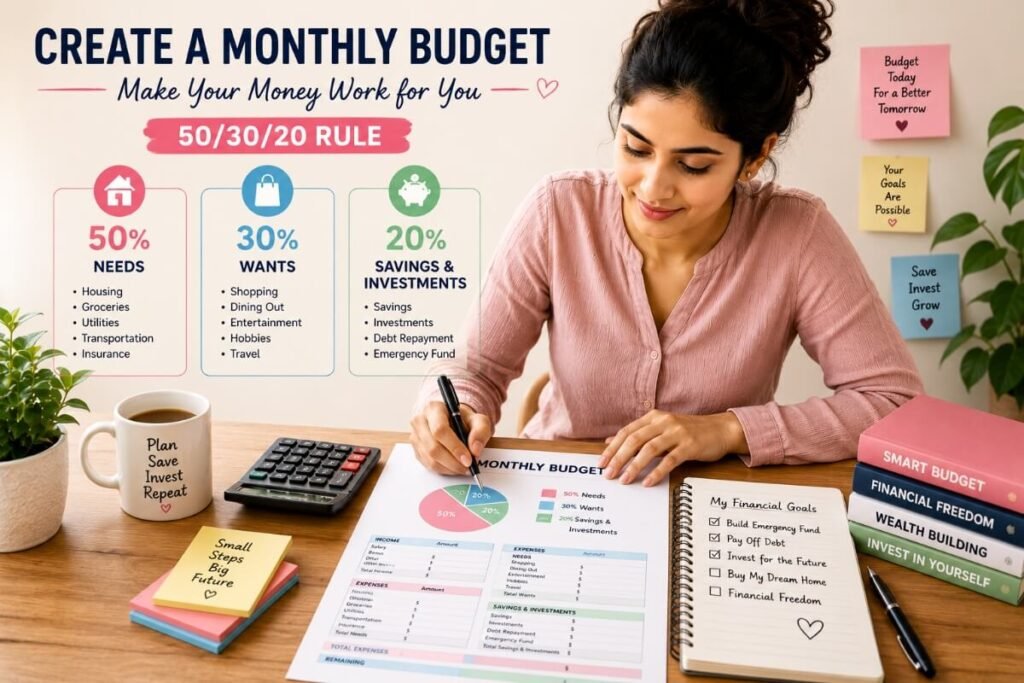
A budget is one of the most powerful tools for managing your money. It tells your money where to go instead of wondering where it went.
Many women think budgeting means giving up everything they enjoy. That’s not true. A good budget simply helps you spend your money wisely while still enjoying life.
Start by calculating your total monthly income. Then list all your essential expenses, such as rent, groceries, transportation, insurance, and utility bills. After that, decide how much you want to save and invest before spending money on non-essential things.
A simple budgeting rule that works well for many people is the 50/30/20 Rule.
- 50% for your needs (housing, food, transportation, bills)
- 30% for your wants (shopping, entertainment, dining out)
- 20% for savings, investments, and debt repayment
Don’t worry if you can’t follow these percentages exactly.Every person’s financial situation is different. The most important thing is to create a budget that you can realistically maintain every month.
Review your budget at the end of each month. If you notice you’re overspending in one area, make small adjustments instead of giving up completely.
Quick Tip: Always pay yourself first. Transfer your savings as soon as you receive your income instead of waiting until the end of the month.
Step 4: Build an Emergency Fund
Life is full of unexpected expenses. Your car may need repairs, you could face a medical emergency, or you might lose your job unexpectedly. An emergency fund helps you handle these situations without going into debt.
An emergency fund is simply money that you set aside for real emergencies. It is not meant for shopping, vacations, or luxury purchases.
If you’re just getting started, aim to save at least $500 to $1,000 as your first milestone. Once you reach that goal, gradually work toward saving three to six months of your living expenses.
You don’t need to save everything at once. Even setting aside a small amount every month can make a big difference over time.
Keep your emergency fund in a separate savings account where it’s easy to access but not too easy to spend.
Building this financial safety net gives you confidence and peace of mind because you’ll know you’re prepared for unexpected situations.
Quick Tip: Set up an automatic monthly transfer to your emergency savings account. Automating your savings makes it much easier to stay consistent.
Step 5: Pay Off High-Interest Debt First
Debt can slow down your financial progress, especially when you’re paying high interest every month.
If you have multiple debts, start by making a list of all of them. Include the outstanding balance, interest rate, and minimum monthly payment for each one.
Focus on paying off the debt with the highest interest rate first while continuing to make the minimum payments on your other debts. This strategy is known as the Debt Avalanche Method and helps you save the most money on interest over time.
Some people prefer the Debt Snowball Method, where you pay off the smallest balance first to build motivation. Both methods work, so choose the one that helps you stay consistent.
At the same time, avoid taking on new unnecessary debt. Try to use credit cards responsibly and only spend what you can repay on time.
Every debt you pay off brings you one step closer to financial freedom.
Quick Tip: Whenever you receive extra income, such as a bonus, tax refund, or freelance payment, consider using part of it to reduce your debt faster.
Step 6: Start Investing for Your Future

Saving money is important, but saving alone is usually not enough to build long-term wealth. Investing allows your money to grow over time and helps you reach bigger financial goals.
Many women avoid investing because they think it’s too risky or too complicated. The truth is that you don’t need to be a financial expert to get started. You simply need to understand the basics and stay consistent.
Before investing, make sure you have an emergency fund and a budget in place. Once those are ready, you can begin investing a small amount every month.
Some common investment options include:
- Mutual Funds
- Index Funds
- Stocks
- Exchange-Traded Funds (ETFs)
- Retirement Accounts
Choose investments that match your financial goals, risk tolerance, and investment timeline. If you’re unsure where to start, consider speaking with a qualified financial advisor.
Remember, investing is a long-term journey. Avoid trying to get rich quickly. Consistency usually delivers better results than chasing short-term profits.
Quick Tip: Even investing a small amount every month can grow significantly over time because of compound growth.
Step 7: Protect Yourself with Insurance
A financial plan is not only about growing your money. It’s also about protecting what you’ve worked hard to build.
Insurance provides financial protection when unexpected events occur. Medical emergencies, accidents, disability, or loss of income can affect anyone.
Depending on your needs, you may consider:
- Health Insurance
- Life Insurance
- Disability Insurance
- Home or Renters Insurance
- Vehicle Insurance
Choosing the right insurance depends on your lifestyle, family responsibilities, and financial situation.
Review your insurance coverage every few years to make sure it still meets your needs.
Insurance is an essential part of every personal financial plan for women because it protects your financial future.
Quick Tip: Don’t choose an insurance policy based only on the lowest premium. Compare the coverage, benefits, claim process, and exclusions before making a decision.
Step 8: Review and Update Your Financial Plan Regularly
Creating a financial plan is not a one-time task. Your life changes, and your financial plan should change with it.
You may get a salary increase, change jobs, get married, have children, start a business, or retire. Each life event can affect your financial priorities.
Set aside time every three to six months to review your financial plan.
During your review, ask yourself:
- Am I following my budget?
- Have I reached any financial goals?
- Do I need to adjust my savings?
- Has my income changed?
- Should I update my investments?
Small adjustments made regularly can keep your financial plan effective for years.
Quick Tip: Add a reminder to your calendar so you never forget your financial review.
Common Financial Planning Mistakes Women Should Avoid
Even the best financial plan won’t work if you repeat the same money mistakes.
Here are some common mistakes to avoid:
- Living without a monthly budget.
- Spending more than you earn.
- Ignoring emergency savings.
- Delaying investments for too long.
- Depending only on one source of income.
- Using credit cards without a repayment plan.
- Not reviewing your financial plan regularly.
Nobody manages money perfectly all the time. The goal is to learn from your mistakes and improve your financial habits little by little.
Frequently Asked Questions (FAQs)
1. What is a personal financial plan?
A personal financial plan for women is a roadmap that helps you manage your income, expenses, savings, investments, and financial goals. It gives you a clear strategy for making better money decisions and building long-term financial security.
2. Why is financial planning important for women?
Financial planning helps women become more confident and financially independent. It prepares you for emergencies, supports your future goals, and reduces financial stress by giving your money a clear purpose.
3. How much should I save every month?
A common recommendation is to save at least 20% of your monthly income. However, if that’s not possible, start with whatever amount you can afford and increase it gradually as your income grows.
4. How much should my emergency fund be?
Most financial experts recommend saving enough money to cover three to six months of your essential living expenses. If you’re just starting, your first goal can be saving $500 to $1,000.
5. When should I start investing?
The best time to start investing is after building a small emergency fund and paying off high-interest debt. Starting early allows your investments to benefit from compound growth over time.
6. Can I create a financial plan with a low income?
Yes. Financial planning is useful at every income level. Even small savings, a simple budget, and consistent financial habits can improve your financial future over time.
7. How often should I review my financial plan?
Review your financial plan every three to six months or whenever a major life event occurs, such as changing jobs, getting married, having children, or receiving a salary increase.
8. What is the biggest mistake people make when creating a financial plan?
One of the biggest mistakes is creating a plan but never reviewing it. Financial planning is an ongoing process, and regular updates help keep your goals realistic and achievable.
Conclusion
Creating a personal financial plan for women may seem overwhelming at first, but it becomes much easier when you take it one step at a time.
Start by understanding your current financial situation, set realistic goals, create a monthly budget, build an emergency fund, pay off high-interest debt, invest for the future, protect yourself with insurance, and review your progress regularly.
Remember, financial success isn’t about earning the highest income. It’s about making smart decisions with the money you already have.
Every small step you take today can lead to greater financial freedom, confidence, and peace of mind tomorrow.
Start your financial planning journey today because your future self will thank you for it.