Budgeting for stay-at-home moms made simple. Learn to manage family expenses, control spending, and create a realistic budget that works for you.
Being a stay-at-home mom can be rewarding, but managing a home and a family comes with plenty of financial decisions.
There are groceries to buy, bills to pay, kids’ needs to cover, unexpected expenses to handle, and hopefully a little money left for savings. When one income is supporting most or all of the household, it can sometimes feel like every dollar already has a job.
That is where a simple budget can make a real difference.
Budgeting for stay-at-home moms is not about saying no to everything you enjoy. It is about knowing where your money is going, deciding what matters most, and making your income work better for your family.
And you do not need a complicated spreadsheet or a perfect financial plan to get started.
In this guide, we will build a practical approach to budgeting for moms that works for different family sizes, income levels, and lifestyles. We will also look at ways to reduce everyday spending without making family life feel restrictive.
The goal is simple: spend with purpose, save where you can, and feel more in control of your money.
- Why Budgeting for Stay-at-Home Moms Can Feel So Difficult
- Before You Build a Budget, Know What Your Money Is Doing
- How to Start Budgeting for Stay-at-Home Moms
- A Simple Budgeting System for Stay-at-Home Moms
- Create a Budget Around Your Family's Real Priorities
- Plan for Expenses That Do Not Happen Every Month
- Use a "Leftover Money" Rule
- Effective Budgeting Tips for Single Moms
- A Monthly Budget Example for a Stay-at-Home Mom
- What If Your Family Income Changes Every Month?
- Build an Emergency Fund One Small Step at a Time
- Find the "Quiet Leaks" in Your Family Budget
- Use a "Wait Before You Buy" Rule
- Make Saving Money Easier With Simple Household Systems
- Budgeting for Moms Should Include Personal Spending Too
- A Budget Should Make Family Life Easier
- Frequently Asked Questions About Budgeting for Moms
- Final Thoughts
Why Budgeting for Stay-at-Home Moms Can Feel So Difficult
A family budget can look simple on paper.
Money comes in. Bills and expenses go out. Whatever remains can go toward savings or other goals.
Real life, however, rarely works that neatly.
Children grow. Grocery prices change. School expenses appear. A car needs maintenance. A medical bill arrives. Your partner’s income may change from month to month. Even small purchases can add up when they happen several times a week.
There is also another challenge that is easy to overlook: a stay-at-home mom may manage a huge part of the household without receiving a personal paycheck for that work.
That does not mean her contribution has no financial value.
In fact, managing meals, shopping, household supplies, appointments, children’s schedules, and daily spending can have a direct effect on how much a family spends.
A useful budget should recognize that reality.
Instead of asking, “How can I spend as little as possible?” ask:”
How can we use the money we have in a way that supports our family’s priorities?”
That small change in thinking can make budgeting feel much more practical.
Before You Build a Budget, Know What Your Money Is Doing
One of the biggest mistakes beginners make is creating spending limits before understanding their actual spending.
For example, you might decide that your family should spend a certain amount on groceries. But if your real spending is consistently much higher, the problem is not necessarily that you lack discipline.
Your budget may simply be unrealistic.
Start by looking at the last 30 days of spending.
Check your bank account, credit card statements, cash spending, automatic payments, and recurring subscriptions. You do not need to judge every purchase. You are simply collecting information.
Look for five basic areas:
- Essential bills — housing, utilities, insurance, transportation, and other regular commitments
- Food and household spending — groceries, cleaning products, personal care, and similar items
- Children and family expenses — school, activities, clothing, childcare, gifts, and other family costs
- Flexible spending — eating out, entertainment, shopping, hobbies, and small treats
- Future money — savings, emergency funds, debt payments, and other financial goals
Once you see the actual numbers, your budget becomes much easier to build.
How to Start Budgeting for Stay-at-Home Moms

You do not have to change everything in one day.
A simple starting point is to build your budget around the money that is actually available to your household.
Step 1: Start With Your Household Income
Write down the income your family can reasonably expect to receive.
If your household has a regular monthly income, this part is straightforward.
If your partner is self-employed, works freelance, earns commissions, or has an irregular income, do not build your lifestyle around the highest month.
A safer approach is to work with a conservative income number and keep extra income for savings, irregular expenses, or months when income is lower.
This gives your family more breathing room.
Step 2: List the Bills That Must Be Paid
Next, write down the expenses that keep your household running.
These may include:
- Rent or mortgage
- Electricity and other utilities
- Internet and phone
- Insurance
- Transportation
- Minimum debt payments
- School or childcare costs
- Regular subscriptions
- Other required monthly payments
These are your starting commitments.
Once you know how much of your income is already committed, you can see what is genuinely available for food, family spending, savings, and everything else.
Step 3: Give Every Remaining Dollar a Purpose
After your essential expenses are covered, decide what the remaining money needs to do.
Some of it may go toward groceries.
Some may be used for children’s needs.
Some can cover fun or personal spending.
And some should ideally move toward savings or future expenses.
The exact percentages will be different for every family. There is no single budgeting formula that works perfectly for every mom.
Your budget should fit your real life, not someone else’s life on social media.
That is the foundation of a budget you can actually stick with.
A Simple Budgeting System for Stay-at-Home Moms
A budget does not need to have dozens of categories to work well. In fact, too many categories can make budgeting feel like another full-time job.
Start with a few groups that are easy to understand and easy to review.
For example, you can divide your monthly money into:
- Home and essential bills
- Food and household needs
- Kids and family
- Personal and fun spending
- Savings and future expenses
You can add more categories later if you need them.
The goal is to make your budget easy enough that you will actually check it every week.
Create a Budget Around Your Family’s Real Priorities
Not every family has the same financial priorities.One family may be trying to build an emergency fund. Another may be paying down debt. Someone else may be preparing for a move, saving for school expenses, or simply trying to make it through the month without relying on a credit card.
That is why a good family budget should start with your priorities.
Ask yourself:
What would make our money situation feel better three or six months from now?
Maybe the answer is having one month of essential expenses saved.
Maybe it is reducing unnecessary subscriptions.
Maybe it is finally getting control of credit card spending.
Choose one or two important goals first instead of trying to fix everything at once.
Small progress is still progress.
Plan for Expenses That Do Not Happen Every Month
One reason a monthly budget can suddenly fall apart is that some expenses are not actually monthly.
Think about:
- Birthdays
- Holidays
- School supplies
- Children’s clothing
- Car maintenance
- Annual insurance payments
- Home repairs
- Medical expenses
- Travel
- Gifts
- Seasonal activities
These expenses may feel unexpected when they arrive, but many of them are actually predictable.
A simple solution is to estimate the yearly cost and divide it across the months.
For example, if you expect to spend about $600 on car maintenance and other vehicle costs during the year, you could set aside around $50 per month.
The exact amount will depend on your situation, but the idea is simple: prepare for future expenses before they become emergencies.
This type of savings can make your monthly budget much less stressful.
Use a “Leftover Money” Rule
Some months will be more expensive than others.
You may spend less on school costs one month and much more the next. A birthday party, family trip, or unexpected repair can also change your spending.
Instead of trying to make every month look identical, give yourself some flexibility.
If you finish a month with money left in a flexible spending category, decide where it should go before the next month begins.
You could:
- Move it to savings
- Put it toward debt
- Keep it for an upcoming family expense
- Add it to your emergency fund
- Use a small portion for something enjoyable
This prevents leftover money from quietly disappearing through random spending.
Effective Budgeting Tips for Single Moms
Single moms may face a different budgeting challenge because there may be less income available to absorb unexpected expenses.
The solution is not simply to cut every enjoyable part of life.
Instead, focus on making your money predictable and protecting the expenses that matter most.
Build Your Budget Around Essential Expenses First
Start with housing, utilities, food, transportation, insurance, healthcare, and other necessities.
Once those are covered, look at flexible spending.
This helps you understand what you can safely spend instead of guessing throughout the month.
Keep a Small Buffer in Your Budget
If possible, do not plan every dollar down to zero.
Even a small monthly buffer can help when groceries cost more than expected or your child suddenly needs something for school.
A buffer is not wasted money.
It is breathing room.
Separate Short-Term and Long-Term Savings
Money for next month’s school expenses is different from money you are building for a long-term financial goal.
Keeping these goals separate can make your savings easier to understand.
You do not need a complicated system. Separate savings categories or simple labeled accounts may be enough.
Look for Recurring Expenses You Can Reduce
Review subscriptions, memberships, insurance costs, phone plans, and other recurring payments from time to time.
Ask:
“Would I choose to pay for this again today?”
If the answer is no, consider cancelling it or finding a less expensive alternative.
A small monthly saving can become meaningful over a full year.
How Moms Can Save Money Without Feeling Deprived
Saving money does not have to mean removing every small pleasure from your family’s life.
A budget becomes difficult to maintain when it feels like punishment.
Instead, look for spending that gives you little value.
For example, you may discover that you are paying for several subscriptions you rarely use, ordering takeout because dinner was not planned, or buying things simply because they were on sale.
Those are often easier places to cut than the things your family genuinely enjoys.
Keep the spending that matters.
Reduce the spending that does not.
That is a much more sustainable way to save money.
Give Yourself a Weekly Money Check-In
You do not need to spend hours every weekend reviewing your finances.
Set aside 10 to 15 minutes once a week.
During this quick check-in, look at:
- What you spent this week
- What bills are coming next
- Whether you are close to any spending limits
- What family expenses are coming up
- Whether you need to move money toward savings
- Anything unusual that needs attention
This small habit can prevent a minor budgeting problem from becoming a major one.
And because you are checking regularly, you do not have to remember everything at the end of the month.
Make Your Budget Flexible, Not Perfect
A family budget is a tool, not a test.
Some months will go exactly as planned.
Other months will not.
Your child may get sick. Your car may need repairs. Your grocery bill may be higher. You may have a family celebration or an expense you simply did not expect.
That does not mean your budget failed.
Adjust it.
Learn from the month.
Then start again.
The best budgeting system is not the one that looks perfect on paper. It is the one that helps you make better decisions consistently, even when real life gets messy.
A Monthly Budget Example for a Stay-at-Home Mom
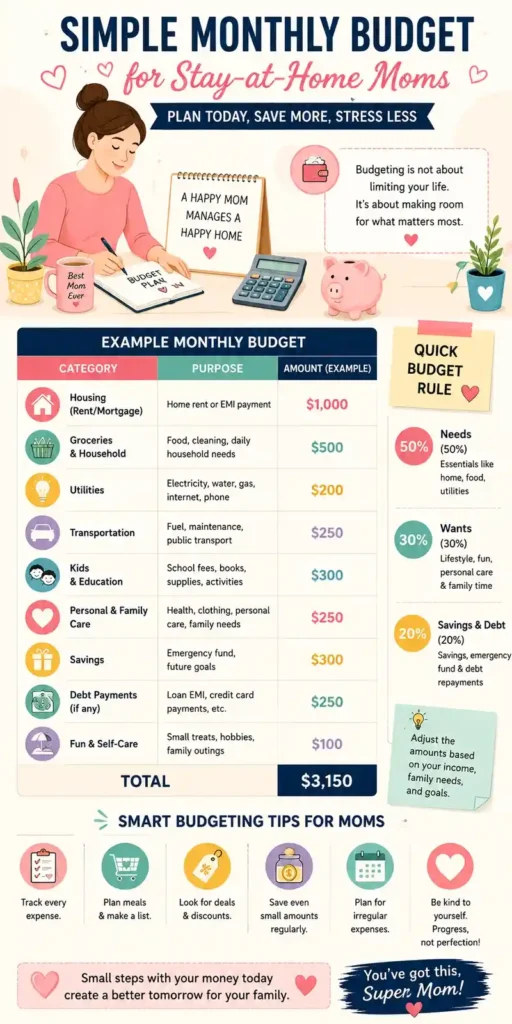
Sometimes a budget is easier to understand when you can see how the pieces fit together.
Here is a simple example of how a household could organize its monthly income.
| Budget Category | Example Amount |
| Housing and essential bills | $1,800 |
| Groceries and household needs | $600 |
| Transportation | $350 |
| Kids and family expenses | $250 |
| Personal and fun spending | $200 |
| Savings and future expenses | $300 |
| Buffer | $100 |
| Total | $3,600 |
These numbers are only an example. Housing, food, transportation, and other costs can be very different depending on where you live.
The important part is not copying these amounts.
Instead, use the structure to create a budget based on your own household income and expenses.
For a family living in a high-cost city, housing may take a much larger share. A family with no car payment may have more room for savings. Another family may need to spend more on healthcare or children’s activities.
A useful budget should reflect those differences.
What If Your Family Income Changes Every Month?
Budgeting can feel harder when your household income is not the same every month.
This can happen when a partner is self-employed, works freelance, receives commissions, or has seasonal income.
In that situation, avoid treating your best month as your normal income.
Instead, look at several recent months and choose a realistic amount that your household can safely depend on.
Then build your essential spending around that number.
When you receive more money than expected, give the extra income a job.
You might use it for:
- Emergency savings
- Upcoming annual expenses
- Debt payments
- A future family goal
- Replacing an old household item
- A small amount of guilt-free spending
This approach can make irregular income feel much more manageable.
Build an Emergency Fund One Small Step at a Time
An emergency fund can make a huge difference to a family budget.
It is money set aside for genuine unexpected expenses, such as a major car repair, urgent home repair, or an unexpected financial problem.
You do not have to save a huge amount immediately.
If your budget is tight, start with a small target.
For example, your first goal could simply be $250 or $500.
Once you reach it, keep building gradually.
The amount you eventually need will depend on your household expenses, income stability, insurance coverage, debt, and personal circumstances.
The key is to start before you actually need the money.
Even small contributions can build a useful financial cushion over time.
Find the “Quiet Leaks” in Your Family Budget

Sometimes the biggest problem is not one large purchase.
It is a collection of small expenses that happen so often that you stop noticing them.
These are your quiet money leaks.
Look for things like:
- Unused subscriptions
- Frequent delivery fees
- Small online purchases
- Convenience foods
- Duplicate household products
- Unplanned shopping trips
- Apps or memberships you rarely use
- Paying extra because a bill was forgotten
- Buying something you already had at home
You do not need to remove every small expense.
Instead, choose the two or three leaks that are easiest to fix.
For example, saving $15 on one subscription and $25 on unnecessary delivery fees gives you $40 more each month.
That is $480 over a year.
Small changes become much more noticeable when you give them time.
Use a “Wait Before You Buy” Rule
Impulse spending can quietly damage a family budget.
A simple waiting rule can help.
For non-essential purchases, give yourself some time before buying.
The waiting period could be 24 hours for a small purchase or several days for something more expensive.
During that time, ask:
Do we need this?
Will we still want it next week?
Do we already own something that can do the same job?
Does it fit this month’s budget?
If the answer is still yes, you can make the purchase without feeling like you made the decision impulsively.
This is especially useful for online shopping, where buying something can take only a few seconds.
Make Saving Money Easier With Simple Household Systems
You do not have to rely on willpower every day.
A few simple systems can make good financial habits easier.
For example, you could:
- Keep a running grocery list instead of making a new list from memory
- Review subscriptions once every few months
- Set automatic transfers toward savings when possible
- Keep a small list of free family activities
- Plan ahead for birthdays and holidays
- Check what you already own before shopping
- Keep a weekly spending note on your phone
The goal is to reduce the number of financial decisions you have to make.
When a good habit becomes part of your routine, you do not have to constantly motivate yourself to do it.
Budgeting for Moms Should Include Personal Spending Too
This part is often overlooked.
A family budget should not only include bills, groceries, children, and savings.
If the budget allows it, give yourself some personal spending money too.
It does not have to be a large amount.
It could cover a coffee with a friend, a book, skincare, a hobby, or something else that makes you happy.
Why include it?
Because a budget that allows no personal spending can become difficult to maintain.
You may follow it for a few weeks and then feel frustrated when you finally spend money on yourself.
A small planned amount can make the entire system feel more realistic.
You are not being irresponsible by including yourself in the family budget.
You are making the budget sustainable.
A Budget Should Make Family Life Easier
The real purpose of budgeting is not to create more rules.
It is to create more clarity.
When you know what needs to be paid, what can be spent, and what you are saving for, money decisions become less stressful.
You do not have to wonder whether every purchase will cause a problem later.
You can look at your plan and make a decision based on information instead of guesswork.
That is especially valuable when you are managing a household and caring for children at the same time.
A good budget gives your money direction.
It also gives you permission to spend on the things that genuinely matter to your family.
Frequently Asked Questions About Budgeting for Moms
1. How do stay-at-home moms start a budget?
Start by writing down your household income and essential monthly expenses. Then track flexible spending, such as groceries, shopping, entertainment, and family activities. Once you know where the money is going, set realistic spending limits and choose one savings goal to work toward.
2. What is a good budget for a stay-at-home mom?
There is no single budget that works for every stay-at-home mom. A good budget covers essential expenses first, then leaves room for food, family needs, personal spending, savings, and unexpected costs. The right amounts depend on household income, location, family size, debt, and lifestyle.
3. How can a stay-at-home mom save money every month?
Start with the expenses that repeat every month. Review subscriptions, reduce unnecessary shopping, plan larger purchases, avoid impulse spending, and look for cheaper alternatives where they make sense. Even a few small monthly savings can become meaningful over a year.
4. What are the best budgeting tips for moms?
The most useful budgeting tips for moms are usually simple: track spending, plan for irregular expenses, keep a small emergency fund, review recurring bills, set savings goals, and leave some room for personal and family enjoyment.
5. How can single moms create a budget on a limited income?
Single moms can start by prioritizing essential expenses such as housing, food, utilities, transportation, healthcare, and minimum debt payments. After that, create small categories for savings and flexible spending. A realistic budget is better than one that looks perfect but is impossible to maintain.
6. How much should a family save each month?
There is no universal amount that every family should save. Start with an amount that fits comfortably into your current budget. If your income or expenses change, adjust the amount. Building the habit of saving regularly can be more important than choosing a perfect number.
7. How do I budget when my household income changes every month?
Use a conservative estimate based on your recent income rather than planning around your highest-earning month. Cover essential expenses first, then use extra income for savings, upcoming irregular expenses, debt, or other financial goals.
8. What should I cut first when my family budget is too tight?
Start with expenses that are optional or provide little value, such as unused subscriptions, frequent convenience purchases, unnecessary delivery fees, or impulse shopping. Try to protect important expenses such as housing, food, healthcare, transportation, and essential family needs.
Final Thoughts
Budgeting for stay-at-home moms is not about creating a perfect financial life.
It is about knowing where your money goes and making intentional choices with what you have.
Start small. Track your spending, plan for the expenses you know are coming, build a little savings cushion, and give your money a clear purpose.
You will not have a perfect month every month—and that is okay.
What matters is that you keep learning, adjusting, and moving forward.
A better budget does not happen overnight. Small money decisions, repeated consistently, can create a much stronger financial foundation for your family.
Continue Reading
Want more simple ways to save money and manage family expenses? Here are a few more guides you may find helpful: 👇
• How to Create a Personal Financial Plan for Women (Step-by-Step Guide)
• Meal Planning on a Budget for Moms: Easy Family Ideas
• Newborn Baby Shopping List in Budget: Affordable Essentials for First-Time Moms
• How to Make a Grocery Budget: Simple Tips for Moms to Save Money
• Free Activities for Kids at Home That Cost Nothing
• Unique Money Saving Ideas for Moms
• Money Saving Tips for Moms | Inspired by Real-Life Lessons
• How Moms Can Save Money with Emily Parker’s $10 Rule
Stay Connected 💛
Found this guide helpful? Save it, share it with another mom who might need it, and subscribe so you don’t lose your way back to us. We share practical, honest ideas to help moms save money, simplify family life, and feel a little more confident every day.You can also follow us on LinkedIn for more helpful tips and new guides.