It’s a Tuesday morning. You’re already running late for school drop-off when the check engine light comes on. Two weeks later, the holiday season hits and every kid’s wish list seems to cost more than last year’s. Nothing about these expenses is truly a surprise, yet they still wreck the budget and leave you stressed. So, what are sinking funds in a budget, and how can they take this stress away?
There’s a simple fix for this, and it doesn’t need a finance degree.
What is a sinking fund in budgeting? A sinking fund is a strategic way to save money for a specific, known future expense by setting aside a small amount each month.
That’s the whole idea. In this guide I’ll walk you through how it works, how it differs from an emergency fund, real examples with numbers, the best sinking fund categories for busy moms, and a step-by-step plan to start this week.
What Is the Purpose of a Sinking Fund?
Most family budgets don’t fall apart because of one big disaster. They fall apart because of a hundred small “I forgot about that” moments: the school trip fee, the annual insurance bill, your mother-in-law’s birthday, the vet visit.
So what is the purpose of a sinking fund? To take big, irregular expenses and turn them into small, predictable monthly amounts. Instead of getting hit with a $1,200 car insurance bill in one go, you quietly set aside $100 every month. When the bill arrives, the money is already there. No credit card, no panic, no borrowing from next month’s grocery money.
For moms, especially single moms managing everything on one income, this brings real peace of mind. You stop reacting to expenses and start planning for them.
Sinking Fund vs. Emergency Fund: What’s the Difference?
A lot of beginners mix these two up. Both are savings, but they do different jobs.
- Emergency Fund: For unexpected, unknown events. Think sudden job loss, a medical emergency, or an urgent home repair nobody saw coming. You hope you never need it.
- Sinking Fund: For expected, known future expenses. Think Christmas shopping, yearly car insurance, or back-to-school supplies. You know you will need it, and you even know roughly when.
Here’s an easy way to remember it. If you can write the expense on your calendar today, it belongs in a sinking fund. If you can’t predict it, that’s what your emergency fund is for.
When you have both, your emergency fund stays untouched for real emergencies instead of getting drained by things you could have planned for.
Practical Sinking Fund Examples (With Real Numbers)
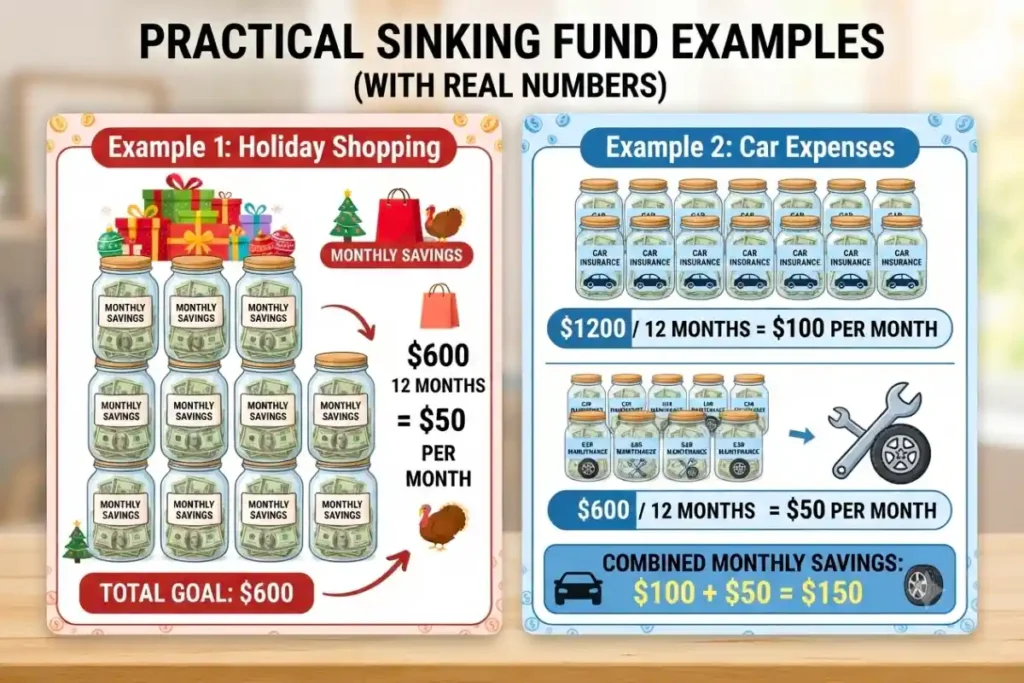
Let’s make this real. Here’s a simple sinking fund example that most families will recognize.
Example 1: Holiday Shopping
Say you usually spend $600 on holiday gifts, decorations, and food. If you start saving in January, you have 12 months to get there.
$600 ÷ 12 months = $50 per month
That’s about $12 a week. Most of us spend that on takeout coffee without noticing. By December, you have your full $600 in hand and you can shop without touching your credit card.
Even if you start late, it still works. Starting in April gives you 9 months, so $600 ÷ 9 = about $67 per month. A bit higher, but still very doable.
The Simple Sinking Fund Calculator Formula
You don’t need an app or a spreadsheet. A basic sinking fund calculator is just this:
Total Cost ÷ Months Left = Monthly Savings Goal
Use it for anything. A $360 school supply and clothing budget with 8 months to go means $360 ÷ 8 = $45 a month. A $300 vet bill expected in 6 months means $50 a month. Once you see the number, the expense stops feeling scary because it’s just a small monthly bill you pay to yourself.
Example 2: A Full Family Sinking Fund Plan
Here’s how it might look for one family over a year:
| Sinking Fund | Yearly Cost | Monthly Amount |
| Holidays | $600 | $50 |
| Car Insurance | $1,200 | $100 |
| Car Maintenance & Tires | $600 | $50 |
| Back-to-School & Kids’ Activities | $360 | $30 |
| Birthdays & Gifts | $240 | $20 |
| Vet & Pet Care | $300 | $25 |
| Total | $3,300 | $275 |
Looking at that $3,300 total might make you nervous. But $275 a month feels much more manageable, and the big stress of the year is already handled.
If $275 is too much right now, don’t worry. Start with just one or two funds and add more as your budget allows. Progress matters more than perfection.
Top Sinking Funds Categories for Moms
Not sure what to save for? These are the most useful sinking funds categories for moms and families. You don’t need all of them. Pick the ones that match your real life.
Kids & School Expenses
School costs show up in bunches. Think back-to-school clothes, shoes, backpacks, supplies, field trips, picture day, sports fees, and uniforms. If you have more than one child, this category can quietly become one of your biggest expenses of the year.
Holidays & Birthdays
This covers Christmas or other festivals, family birthdays, anniversaries, and even teacher gifts. These dates never change, so there’s no reason to be caught off guard. Many moms find it easier to keep “Holidays” and “Birthdays” as two separate funds so they can see exactly where the money goes.
Vehicle Costs
Cars are rarely cheap. Set money aside for annual insurance, registration, oil changes, scheduled maintenance, and tire replacement. Even if your car runs perfectly today, regular wear and tear is predictable, and a fund here means a repair bill never turns into a crisis.
Home & Pet Care
Homes and pets need regular attention. Seasonal home maintenance, small repairs, cleaning supplies, and pest control all fit here. For pets, think vet checkups, vaccinations, and grooming. If you rent, you might include renter’s insurance or moving costs.
Other Ideas Worth Considering
Once you’re comfortable, you can add categories like medical and dental copays, family vacations, kids’ birthday parties, a new phone or laptop, and annual subscriptions. The best fund is the one that solves a problem you actually face.
How to Start Your First Sinking Fund (Step-by-Step)
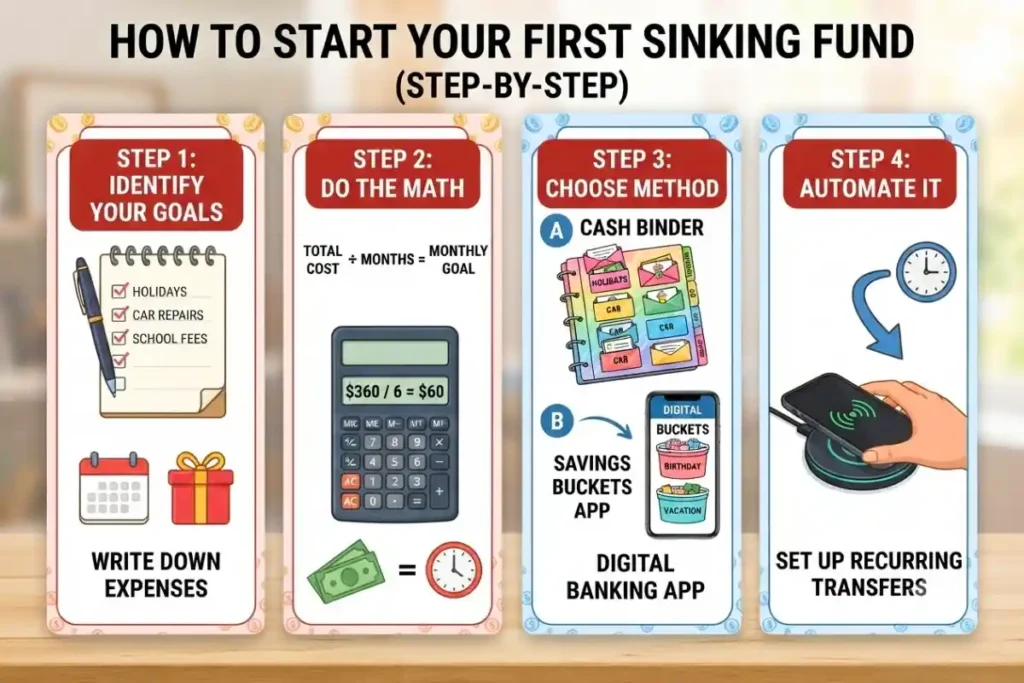
You can set up your first fund today, even if you only have ten minutes. Here’s how.
Step 1: Identify Your Goals
Grab a pen and paper and look at the next 12 months. Check your calendar, bank statements, and last year’s receipts. Write down every expense you can see coming: birthdays, holidays, insurance renewals, school fees, vet visits. Don’t worry about being exact. A rough estimate is a great start.
Step 2: Do the Math
Use the formula from earlier: Total Cost ÷ Months Left = Monthly Savings Goal. Do this for each expense on your list, then add up the monthly amounts. If the total is more than you can manage, remove the less urgent items or start with the most important two or three. You can always add more later.
Step 3: Choose Your Method
There are two popular ways to keep your sinking fund money, and both work well. It just depends on your style.
- The Cash Stuffing / Cash Binder Method (best for beginners): Get a small binder with plastic cash envelopes, and label each one with a category such as “Holidays” or “Car.” Every payday, put the planned amount of cash into each envelope. It’s very visual, and you can see your savings grow. Because the money is physical, it also feels harder to spend on impulse. The downside is that cash can be lost or stolen, and it earns no interest.
- Separate High-Yield Digital Savings Accounts: Many online banks let you open several savings accounts, or create “buckets” or “vaults” inside one account, and name them (for example, “Christmas 2026”). Your money stays safe, often earns more interest than a regular savings account, and is easy to track on your phone. Before opening one, check that the bank is insured (in the US, look for FDIC insurance) and read the fee details.
Not sure which to pick? Many moms start with a cash binder to build the habit, then move to digital accounts once the routine feels natural.
Step 4: Automate It
This is the step that makes everything stick. Set up an automatic transfer on payday from your checking account to your sinking funds. If you’re using cash envelopes, do the stuffing the same day you get paid. When saving happens automatically, you don’t need willpower. It’s just part of your routine, like paying the electricity bill.
Common Sinking Fund Mistakes to Avoid
A few small slips can make this system harder than it needs to be.
- Starting with too many funds. Begin with two or three and build from there.
- Dipping into the fund for something else. If you must borrow from it, put the money back as soon as you can.
- Forgetting to update your numbers. Prices go up, so check your totals once a year.
- Giving up after one bad month. If you miss a month, don’t quit. Just adjust the next month’s amount and keep going.
Frequently Asked Questions About Sinking Funds
1. What is a sinking fund in simple words?
A sinking fund is money you set aside a little at a time for an expense you already know is coming, like holiday gifts, school fees, or yearly car insurance. By the time the bill arrives, the money is ready.
2. What is the purpose of a sinking fund?
Its purpose is to break a big, irregular expense into small monthly amounts, so you don’t have to use a credit card or take money from your regular budget when the bill shows up.
3. What is the difference between a sinking fund and an emergency fund?
A sinking fund is for expenses you know about and can plan for, like Christmas or car insurance. An emergency fund is for surprises you can’t predict, like a sudden job loss or a medical emergency.
4. How much should I put into a sinking fund each month?
Use this simple sinking fund calculator formula: Total Cost ÷ Months Left = Monthly Savings Goal. For example, if you need $600 for the holidays and have 12 months, you save $50 a month.
5. How many sinking funds should I have?
There’s no fixed number. Beginners do best starting with two or three funds that match their biggest yearly expenses, then adding more as their budget grows.
6. Can I use my sinking fund for an emergency?
It’s better not to. If you really have to, put the money back as soon as you can, so the expense you planned for isn’t left uncovered.
Conslusion: Take Control of Your Family Finances, One Small Step at a Time
Money stress rarely comes from the expenses themselves. It comes from feeling surprised and unprepared. Sinking funds flip that around. You decide in advance where your money goes, so Christmas, car repairs, and school fees stop feeling like emergencies and start feeling like things you’ve already handled.
You don’t have to be perfect, and you don’t need a big income to begin. Even $10 or $20 a month toward one goal is a real start. Pick one expense you know is coming, work out the number, and set up that first transfer today. Your future self will thank you.
Read More Money Saving Tips For Moms 👇
• How to Celebrate Christmas on a Budget: A Stress-Free Guide for Moms
• 10 Fun and Free Indoor Toddler Activities at Home (That Cost $0)
• 50 Envelope Savings Challenge: How to Save $1,275 Step by Step
• How to Save 10K This Year with the Simple $27.40 Savings Challenge
• Budgeting for Stay-at-Home Moms: Simple Ways to Save Money
• My Mom’s Secret Money Management Tips That Changed Our Life Forever
Save This Guide for Later
Found this helpful? Bookmark this page so you can come back to it whenever you’re planning your next sinking fund.
Share It With a Mom Who Needs It
Know a friend, sister, or fellow mom who is tired of surprise bills? Share this guide with her on WhatsApp, Facebook, or Pinterest. One small step can help her feel in control of her money too.