Procurement tips for new moms to shop smarter, save money on baby essentials, avoid unnecessary purchases, and stay within your baby budget.
Growing up, my mom used to tell me stories about my early months — how she’d bought three different feeding bottles before realizing I only ever took to one, and a wardrobe of tiny outfits I outgrew before half of them were even worn. She always said the same thing: “You don’t need as much as you think you do.”
Years later, as I started writing about personal finance and talking to new parents about their budgets, I realized her advice held up better than most of the shopping guides out there. The families who spent the least regret weren’t the ones who bought the most — they were the ones who bought thoughtfully.
That’s really what this guide is about. If you’re staring at a long newborn checklist feeling unsure what’s actually necessary, here’s how to shop smarter, spend less, and still have everything your baby truly needs.
- Procurement Tips for New Moms: Start With What Your Baby Actually Needs
- Procurement Tips for New Moms That Can Make Baby Shopping Easier
- Make a Baby Budget Before You Start Shopping
- Do Not Buy the Whole Baby Store at Once
- Compare the Cost Per Use, Not Just the Price
- Be Careful With Baby Gadgets
- Use Hand-Me-Downs Where They Make Sense
- Build Your Shopping List Around Your Real Life
- Avoid Buying Too Many Clothes in One Size
- Make Diaper Shopping More Flexible
- Plan Feeding Purchases Carefully
- Use a 24-Hour Rule for Non-Essential Baby Purchases
- Think About Storage Before You Buy
- Ask for Useful Gifts Instead of More Things
- A Simple Baby Shopping Routine That Works
- The Most Important Money-Saving Lesson for New Moms
- Frequently Asked Questions About Procurement Tips for New Moms
- Final Thoughts
- Continue Reading: More Money-Saving Guides for Moms 👇
Procurement Tips for New Moms: Start With What Your Baby Actually Needs
I remember how easy it is to look at a baby shopping list and feel that almost everything is important. A tiny outfit looks necessary, a new feeding gadget looks useful, and suddenly a few small purchases have turned into a large bill.
The problem is not buying things for a new baby. The problem is buying too much before you know what you will actually use.
Good procurement for new moms is really about making thoughtful buying decisions. Start with the basics, leave room for unexpected needs, and avoid spending money simply because something is popular.
Procurement Tips for New Moms That Can Make Baby Shopping Easier
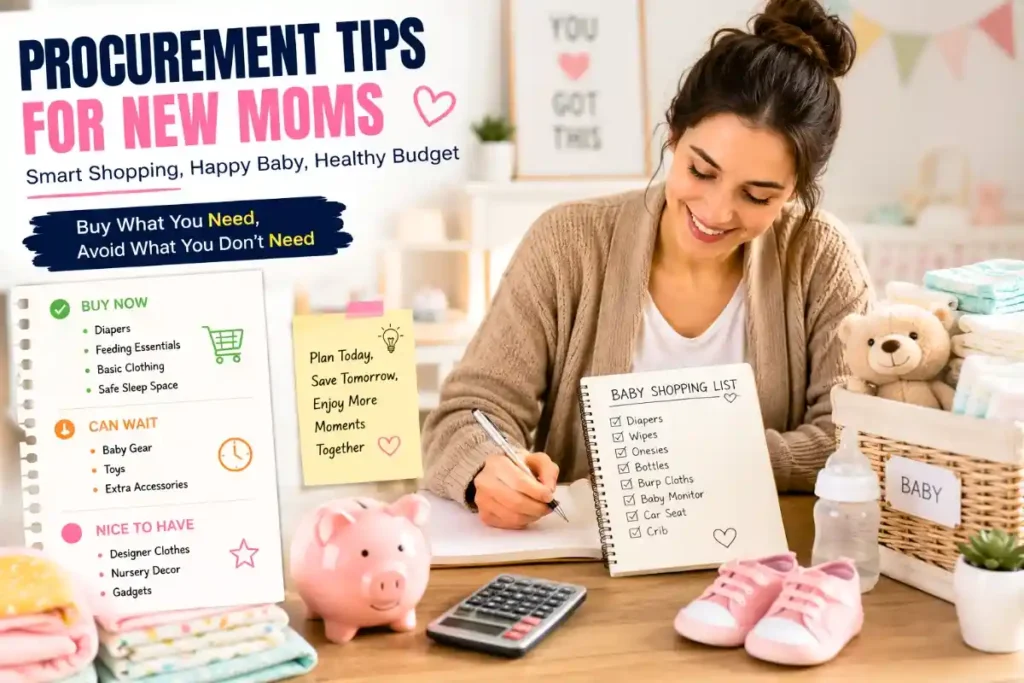
Before you buy anything, take a few minutes to separate your shopping into three simple groups:
- Need now: Items your baby will use from the first days.
- Can wait: Things that may become useful later.
- Nice to have: Products that make life more convenient but are not essential.
This simple system can stop a long baby shopping list from becoming a long shopping bill.
For a first-time mom, this is especially helpful because it is difficult to know which products will actually fit into your daily routine.
Make a Baby Budget Before You Start Shopping
A baby budget does not need to be complicated.
Write down the amount you can comfortably spend, then divide it between the most important categories.
| Category | Priority |
| Safe sleep space | High |
| Diapers | High |
| Basic clothing | High |
| Feeding supplies | High |
| Car seat | High |
| Bath and hygiene items | Medium |
| Toys and entertainment | Low |
| Nursery decoration | Low |
The exact budget will be different for every family in the US, UK, Canada, Europe, and other parts of the world.
The important part is setting your limit before you start shopping.
That one step makes it much easier to say no to things you do not really need.
Do Not Buy the Whole Baby Store at Once
One mistake new parents can easily make is trying to prepare for every possible situation before the baby arrives.
You do not need to own six different types of bottles, a huge wardrobe, every baby gadget, and every product recommended on social media.
Start small.
Buy the things you know you will use immediately. Once your baby arrives, you will have a much better idea of what your family actually needs.
This approach also protects your budget from purchases that end up sitting unused.
Use a “Buy Later” List
Instead of putting every interesting product into your shopping cart, keep a separate list called Buy Later.
When you see something that looks useful, add it to that list instead of purchasing it immediately.
After a few days, ask:
- Do I still need it?
- Will I use it regularly?
- Do I already own something that does the same job?
- Can I borrow it?
- Can I wait another month?
You may be surprised by how many items disappear from the list without ever needing to be purchased.
Compare the Cost Per Use, Not Just the Price
The cheapest item is not always the best deal.
Imagine one baby product costs $10 but needs to be replaced several times, while another costs $20 and lasts much longer.
Looking only at the price makes the first option look cheaper.
Looking at how often you will use and replace it gives you a better picture.
This is a useful money-saving habit for baby clothes, feeding supplies, storage items, and many other household purchases.
Be Careful With Baby Gadgets
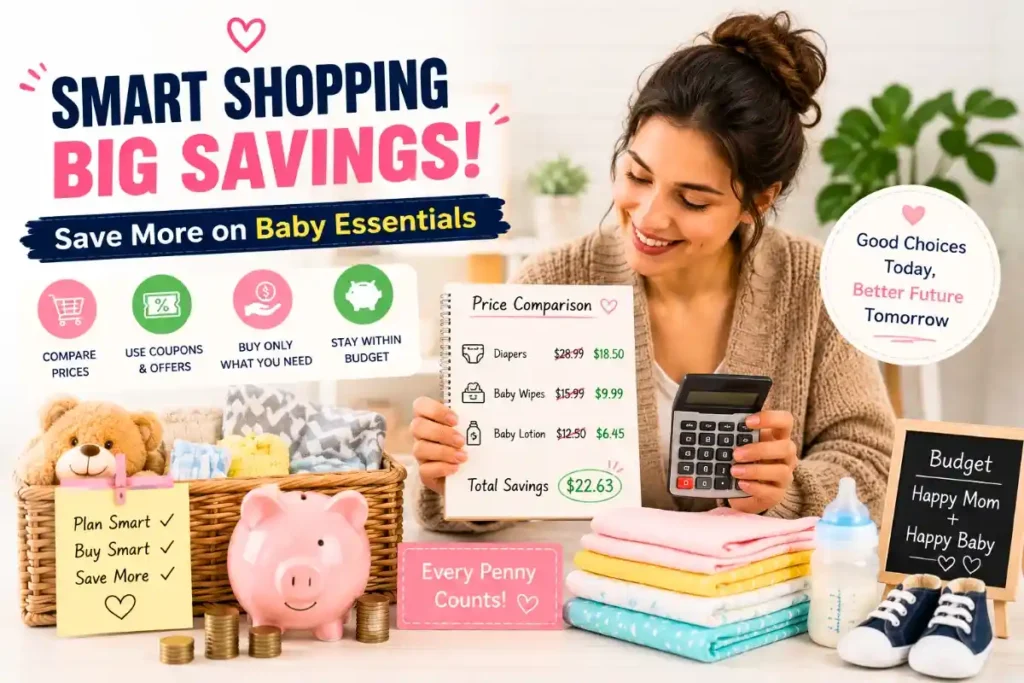
Baby products are marketed extremely well.
A product can make you feel that your baby will sleep better, eat better, or make your life easier simply because the advertisement says so.
Before buying an expensive gadget, stop and ask:
What problem is this actually solving?
If the answer is unclear, wait.
Some parents love certain baby gadgets, while others barely use them. You do not need to discover which group you belong to before the baby arrives.
Use Hand-Me-Downs Where They Make Sense
Babies grow quickly, and many baby clothes are used for a surprisingly short time.
If trusted family members or friends offer clean, suitable clothing, blankets, books, or other appropriate items, accepting them can reduce your baby expenses.
You can also look at local second-hand options where appropriate.
But do not treat every used baby product the same way.
For safety-critical products, check current safety guidance and the item’s condition carefully before deciding whether buying used is appropriate.
Build Your Shopping List Around Your Real Life
A shopping list copied from another parent may not fit your family.
Someone living in a cold Canadian climate may need different clothing from a family living in a warm part of Europe.
A parent who drives every day may have different transportation needs from someone who mostly walks or uses public transport.
Your home, climate, transport, feeding choices, family support, and budget all matter.
That is why the best newborn shopping list is not necessarily the longest one.
It is the one that fits your actual life.
Avoid Buying Too Many Clothes in One Size
Newborn clothes are one of the easiest areas to overspend.
They are small, cute, and difficult to resist.
But babies grow quickly.
Instead of buying a large collection in one size, buy a smaller number of practical outfits and see how your baby grows.
Simple clothes that are easy to wash and comfortable to wear will usually get much more use than outfits bought mainly for photographs.
Make Diaper Shopping More Flexible
Diapers can become a regular expense, so they deserve a little planning.
Do not automatically buy a huge supply of one size before you know how quickly your baby will move between sizes.
Compare the price of different brands and pack sizes, but also pay attention to how well a product works for your baby.
A cheaper pack is not really cheaper if a large part of it goes unused.
If you use disposable diapers, check store discounts, loyalty programs, and subscription prices when available in your area.
If you use cloth diapers, calculate the full cost, including washing and drying, rather than looking only at the purchase price.
Plan Feeding Purchases Carefully
Feeding is another area where new parents can easily buy more than necessary.
If you plan to breastfeed, you may not need every feeding product available before your baby arrives.
If you plan to use formula, avoid buying large quantities before you know what works for your baby and what is available locally.
The same rule applies to bottles.
Start with a small number rather than purchasing a large collection immediately.
Your baby’s needs and your routine will tell you what to buy next.
Use a 24-Hour Rule for Non-Essential Baby Purchases
This is one of the easiest procurement tips for new moms to use.
When you want something that is not urgent, wait 24 hours.
For a more expensive purchase, wait longer.
During that time, look at the product again and ask whether you still want it for the same reason.
Waiting does not mean you can never buy something.
It simply gives you a chance to make the decision without the excitement of a new product influencing you.
Think About Storage Before You Buy
This sounds small, but it can save money.
Before buying another pack of baby supplies, look at what is already in your home.
Do you have three partly used products?
Are there clothes your baby has already outgrown?
Are there unopened items hidden in a cupboard?
Buying more while older supplies are forgotten is an easy way to waste money.
A quick check of your storage areas before shopping can prevent duplicate purchases.
Ask for Useful Gifts Instead of More Things
Friends and family often want to buy something for a new baby.
If you have a baby registry or people ask what you need, be specific.
Useful gifts may include items you were already planning to buy.
You can also ask for practical help instead of another product, depending on your family and circumstances.
The goal is not to collect as many baby items as possible.
It is to make the first months easier.
A Simple Baby Shopping Routine That Works
You can make your shopping process much easier by following the same routine every time.
Step 1: Check what you already own.
Step 2: Look at your remaining baby budget.
Step 3: Write down only the items you genuinely need.
Step 4: Compare prices from a few reliable sellers.
Step 5: Wait before buying non-essential items.
Step 6: Review the purchase after you receive it.
That last step is useful because it teaches you what your family actually uses.
Over time, your shopping decisions become much easier.
The Most Important Money-Saving Lesson for New Moms
You do not have to become an expert shopper to manage baby expenses well.
You simply need to slow down.
Check before buying.
Compare before paying.
Wait before purchasing something non-essential.
And most importantly, do not let advertising decide what your baby needs.
A newborn does not need the most expensive version of everything.
Your goal is not to create a perfect nursery or own every product recommended online. Your goal is to provide what your baby genuinely needs while keeping your family’s finances comfortable.
Frequently Asked Questions About Procurement Tips for New Moms
What does procurement mean for new moms?
Procurement simply means planning and making purchases carefully. For new moms, it can mean deciding what baby items are actually needed, comparing prices, setting a budget, and avoiding unnecessary purchases.
How can new moms save money when buying baby essentials?
Start with a list of essential items, compare prices, accept suitable hand-me-downs, avoid buying too much in one size, and wait before purchasing non-essential products. Buying less can sometimes save more than finding a bigger discount.
What should a first-time mom buy before the baby arrives?
Focus on basic needs such as a safe sleeping space, suitable clothing, diapers, feeding supplies based on your plans, basic hygiene items, and an appropriate car seat where required. Many other products can be purchased later if they become necessary.
Should new moms buy baby products in bulk?
Not always. Bulk buying can be useful for products you know your baby will use regularly, but it can also create waste if your baby grows out of a size or does not use a particular product. Start with smaller quantities when you are unsure.
What is the best way to avoid overspending on baby products?
Create a budget, separate essential purchases from optional ones, and use a waiting period for non-essential items. Before buying anything, ask yourself whether you need it now or simply like the idea of having it.
Final Thoughts
Smart baby shopping is not about finding the cheapest version of everything. It is about knowing what you need, when you need it, and how much you are comfortable spending.
A little planning can make a big difference. Compare prices, avoid buying too much too early, use suitable hand-me-downs, and give yourself time before making non-essential purchases.
Most importantly, do not feel pressured to create the “perfect” baby setup. Every family is different, and your shopping decisions should fit your baby’s needs, your lifestyle, and your budget.
You do not have to buy everything today. Start with what matters most, and let the rest come later.
Continue Reading: More Money-Saving Guides for Moms 👇
If you found these procurement tips for new moms helpful, keep exploring our practical money-saving guides for moms. You can learn more about reducing everyday family expenses, planning a household budget, and making smarter spending decisions without making life complicated.
• Frugal Habits of Depression-Era Housewives That Still Save Money Today
• Budgeting for Stay-at-Home Moms: Simple Ways to Save Money
• Meal Planning on a Budget for Moms: Easy Family Ideas
• Newborn Baby Shopping List in Budget: Affordable Essentials for First-Time Moms
• How to Make a Grocery Budget: Simple Tips for Moms to Save Money
• Free Activities for Kids at Home That Cost Nothing
• Unique Money Saving Ideas for Moms
• Money Saving Tips for Moms | Inspired by Real-Life Lessons
• How to Create a Personal Financial Plan for Women (Step-by-Step Guide)
Save this guide for later and share it with another first-time mom who may find it useful.
💛 Stay Connected
Enjoyed this guide? Share it on WhatsApp, subscribe with your email for more simple money-saving tips, and follow us on LinkedIn so you never miss a new guide.