Saving money can feel difficult when every month already has bills, groceries, family expenses, and small unexpected costs. The 50 envelope savings challenge gives you a simple way to make saving feel more like a small daily or weekly task instead of one big financial goal. You use 50 envelopes, assign amounts from $1 to $50, and save each amount as you complete the challenge. By the end, you can save exactly $1,275.
This guide explains the 50 envelope money saving challenge in a simple way, including the math, different ways to use it, how to track your progress, and how to make it practical for real family budgets.
- 50 Envelope Savings Challenge: What Is It?
- 50 Envelope Money Saving Challenge: How Much Can You Save?
- 50 Envelope Money Challenge: Do You Have to Save Every Day?
- 50 Envelope Savings Challenge: The Smart Way to Choose Envelopes
- 50 Envelope Savings Challenge for a Real Family Budget
- 50 Envelope Savings Challenge: A Better Way to Start
- 50 Envelope Money Challenge: Use Your Extra Money Wisely
- 50 Envelope Savings Challenge: Create a Simple Tracking System
- 50 Envelope Savings Challenge: Keep the Money Separate
- 50 Envelope Money Saving Challenge: What If You Miss a Week?
- 50 Envelope Savings Challenge: Make It Easier for Moms
- 50 Envelope Money Challenge: Don't Borrow From Your Future Savings
- 50 Envelope Savings Challenge: Turn Small Wins Into a Habit
- 50 Envelope Money Challenge: What to Do With Unexpected Savings
- 50 Envelope Savings Challenge: A Simple Monthly Plan
- 50 Envelope Money Saving Challenge: Digital or Cash?
- 50 Envelope Savings Challenge: Make the Challenge Fit Your Income
- 50 Envelope Savings Challenge: A Quick Progress Check
- 50 Envelope Money Challenge: What If $1,275 Is Not Your Goal?
- 50 Envelope Savings Challenge: What Happens After You Finish?
- 50 Envelope Money Saving Challenge: What If You Need the Money Early?
- 50 Envelope Savings Challenge: How to Finish Strong
- 50 Envelope Savings Challenge: The Simple Rules to Remember
- 50 Envelope Savings Challenge FAQs
- Final Thoughts on the 50 Envelope Savings Challenge
- Continue Reading: More Money-Saving Tips for Moms
- Stay Connected 💓
50 Envelope Savings Challenge: What Is It?
The 50 envelope savings challenge is a savings game built around 50 numbered envelopes.
You label your envelopes with numbers from 1 to 50. Each number represents the amount of money you will put into that envelope.
For example:
| Envelope | Amount to Save |
| 1 | $1 |
| 2 | $2 |
| 3 | $3 |
| 10 | $10 |
| 20 | $20 |
| 30 | $30 |
| 40 | $40 |
| 50 | $50 |
You continue until all 50 envelopes have been completed.
The interesting part is that you do not have to save the same amount every time. Some days may require only $3 or $8, while another day may require $35 or $50.
That variety is what makes the challenge feel different from a normal savings plan.
50 Envelope Money Saving Challenge: How Much Can You Save?
If you complete all 50 envelopes from $1 through $50, the total is:
$1 + $2 + $3 + … + $50 = $1,275
So, the full 50 envelope money saving challenge can help you save $1,275.
You do not need to guess how much you will have at the end. The target is built into the challenge from the beginning.
There is also a useful way to look at the average:
$1,275 ÷ 50 = $25.50
So, if you complete one envelope at a time, the average amount saved per envelope is $25.50.
However, you will not actually save $25.50 each time. Your amount changes depending on the envelope you choose.
Note: The $1,275 target is based on US dollar amounts. If you live in the UK, Canada, Europe, or another country, you can use your local currency and adjust the amounts to fit your income and budget. Prices and everyday costs can also vary by location.
50 Envelope Money Challenge: Do You Have to Save Every Day?
No.
This is one of the best things about the 50 envelope money challenge.
You can choose a schedule that matches your income and family budget.
Option 1: One Envelope Every Day
If you complete one envelope each day, you will finish in 50 days.
The average saving works out to $25.50 per day, although the actual amount will change from envelope to envelope.
This option can work well for someone who has enough flexible money available each day.
Option 2: One Envelope Every Week
If daily saving feels too much, complete one envelope every week.
You will finish the challenge in about 50 weeks, which is close to one year.
This can be easier for families because you can plan the saving around your weekly budget.
Option 3: Pick More Than One Envelope When You Can
You can also make the challenge flexible.
For example, during a week when you spend less than expected, you might complete two smaller envelopes.
During a more expensive week, you might complete only one small envelope.
The goal is not to make the challenge stressful. The goal is to build savings consistently.
50 Envelope Savings Challenge: The Smart Way to Choose Envelopes
You do not have to start with envelope #1 and move upward in order.
In fact, mixing the amounts can make the challenge more interesting.
For example, you could put all 50 envelopes in a box and randomly choose one whenever you are ready to save.
If you pick $7, you put $7 into that envelope.
If you later pick $42, you need to decide whether your budget can handle it.
If $42 is too much that week, simply put the envelope back and choose a smaller amount.
This gives you more control than blindly following a fixed order.
50 Envelope Savings Challenge for a Real Family Budget
For moms and families, the challenge should fit around real life.
Before starting, look at your normal monthly expenses:
- Housing
- Groceries
- Utilities
- Transportation
- Child-related expenses
- Debt payments
- Subscriptions
- Emergency expenses
- Other regular bills
Then decide how much flexible money you can safely use for the challenge.
For example, if $50 would make your grocery budget difficult, there is no reason to force yourself to complete the $50 envelope immediately.
You can choose smaller envelopes first and complete the larger ones when your budget is stronger.
The challenge should help your finances—not create another financial problem.
50 Envelope Savings Challenge: A Better Way to Start
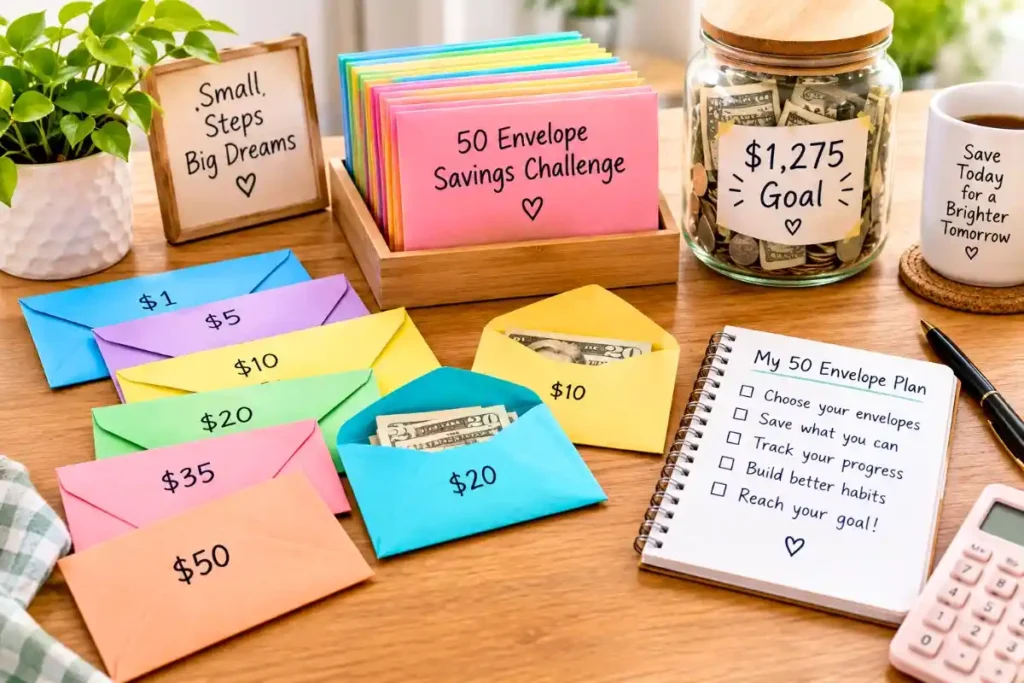
Starting with the smallest envelope is not always the best choice.
If you already know that some weeks are easier financially than others, you can use the challenge around your cash flow instead of following a strict order.
For example, you could complete:
$5 → $18 → $3 → $35 → $7
This keeps the challenge flexible and stops it from feeling like another monthly bill.
A simple rule is:
Choose the envelope that your budget can comfortably handle today.
If money is tight, choose a smaller amount. If you have extra money after your regular expenses, you can choose a larger envelope.
50 Envelope Money Challenge: Use Your Extra Money Wisely
The challenge can become much easier when you connect it with money you were not planning to spend.
Look for small amounts such as:
- Money left from your weekly grocery budget
- A cashback reward
- A refund you were not expecting
- Money saved from cooking at home
- A small amount left after paying regular bills
- Money from selling unused household items
- A gift or cash amount you decide to save
- Extra income from a small side activity
For example, suppose you planned to spend $80 on groceries but your final bill was $68.
You have $12 left in your planned grocery budget.
Instead of automatically spending that $12 somewhere else, you could use it for a $12 envelope.
This is a useful habit because you are not necessarily finding completely new money. You are redirecting money that was already available.
50 Envelope Savings Challenge: Create a Simple Tracking System
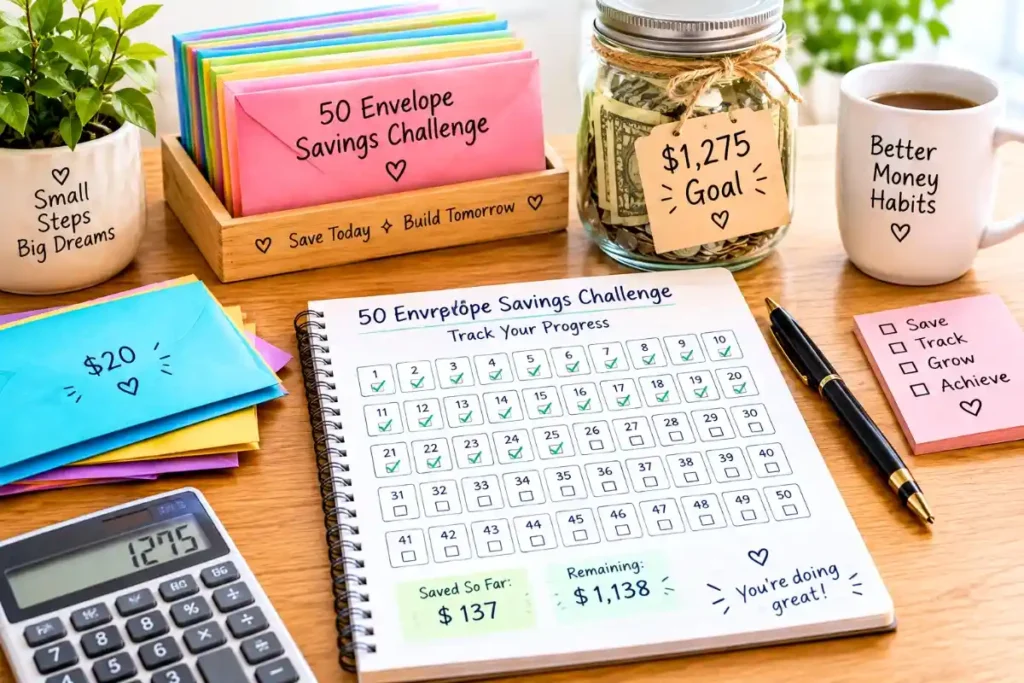
One of the easiest ways to lose motivation is not knowing how far you have come.
You do not need an expensive planner or a special app.
A simple tracking sheet can be enough.
Create 50 small boxes and write the envelope amount inside each one.
Every time you complete an envelope, mark it as done.
For example:
| Completed | Amount |
| ✓ | $4 |
| ✓ | $11 |
| ✓ | $25 |
| ☐ | $32 |
| ☐ | $46 |
| ☐ | $50 |
You can also keep a running total.
If you have completed 10 envelopes worth a combined $137, write:
Saved so far: $137 Remaining: $1,138
Seeing the number increase can make the challenge feel much more rewarding.
50 Envelope Savings Challenge: Keep the Money Separate
Try not to mix your challenge money with your everyday spending money.
If you are using physical envelopes, keep them together in one safe place.
If you prefer digital banking, you can create a separate savings space or savings account if your bank provides one.
The important thing is to make the money easy to track but slightly harder to spend accidentally.
A separate place also gives you a clear answer when you ask yourself:
“How much have I actually saved?”
50 Envelope Money Saving Challenge: What If You Miss a Week?
Missing a week does not mean the challenge has failed.
Family expenses can change. A large bill can arrive. School costs, travel, repairs, or other unexpected expenses may come up.
If you cannot complete an envelope, simply mark it as pending and continue when your budget allows.
You do not need to double the next payment just because you missed one.
For example:
• Week 1: $15 saved
• Week 2: $20 saved
• Week 3: No saving
• Week 4: $10 saved
That is still progress.
A savings challenge should encourage a better habit, not make you feel guilty when real life happens.
50 Envelope Savings Challenge: Make It Easier for Moms
For moms managing family expenses, timing can make a big difference.
Instead of choosing an envelope randomly every time, you can connect your saving with predictable moments.
For example:
After payday: Complete one envelope.
After grocery shopping: Save part of any planned grocery money left over.
At the end of the month: Complete a larger envelope if the household budget has room.
After selling unused items: Put part of the money directly into the challenge.
This makes saving part of your normal money routine instead of something you have to remember every day.
50 Envelope Money Challenge: Don’t Borrow From Your Future Savings
One simple rule can protect the progress you make:
Once an envelope is completed, try to leave that money alone.
If you keep taking money back for everyday purchases, the challenge becomes a cycle of saving and spending rather than actual progress.
Before starting, decide what the $1,275 will eventually be used for.
It could become:
- An emergency fund
- A family financial cushion
- A future expense fund
- A debt payment
- A planned purchase
- Part of a larger savings goal
Having a purpose can make it easier to leave the money untouched.
Note: Your ideal savings amount depends on your income, expenses, currency, and local cost of living. Never reduce essential spending just to complete a savings challenge.
50 Envelope Savings Challenge: Turn Small Wins Into a Habit
A savings challenge becomes much easier when you stop thinking about the final $1,275 and focus on the envelope in front of you.
Saving $6 today may not feel exciting. But completing that envelope means you are one step closer to your goal.
Try to notice these small wins:
- Your first completed envelope
- Your first $100 saved
- Your first 10 envelopes completed
- Reaching $500
- Completing half of the challenge
- Finishing your final envelope
These milestones can keep the challenge enjoyable, especially when your budget is already busy with family expenses.
50 Envelope Money Challenge: What to Do With Unexpected Savings
Sometimes you may save money without planning to.
Maybe you find a cheaper internet plan, cancel a subscription you no longer use, cook several meals at home, or spend less than expected during a shopping trip.
Instead of treating every saving as extra spending money, you can use part of it to complete an envelope.
For example, if you save $20 by changing a monthly service, you could put that $20 toward envelope #20.
This creates a useful connection:
Spend less → keep the difference → add it to savings.
Over time, these small decisions can make the challenge feel much more manageable.
50 Envelope Savings Challenge: A Simple Monthly Plan
If saving every few days does not suit your lifestyle, you can organise the 50 envelopes around your monthly budget.
Here is one simple approach:
| Month | Suggested Focus |
| Month 1 | Complete smaller envelopes |
| Month 2 | Mix small and medium envelopes |
| Month 3 | Use extra-income opportunities |
| Month 4 | Continue with comfortable amounts |
| Month 5 | Review your progress |
| Month 6 | Complete larger envelopes when possible |
| Later Months | Finish the remaining envelopes |
This is not a fixed schedule. You can change it whenever your financial situation changes.
The important thing is to keep moving through the envelopes rather than worrying about doing everything perfectly.
50 Envelope Money Saving Challenge: Digital or Cash?
The original idea works naturally with physical envelopes, but you do not have to use cash.
A digital version can be easier if you rarely use cash.
You could create a simple list like this:
• $1 — Done
• $2 — Done
• $3 — Done
• $4 — Pending
• $5 — Done
Then transfer the selected amount into a separate savings account or savings space.
A digital version may also be more practical in countries where cash payments are less common.
The method matters less than keeping the money separate and tracking your progress.
50 Envelope Savings Challenge: Make the Challenge Fit Your Income
Not everyone has the same income, and not every month looks the same.
If your income changes, you can make the challenge more flexible.
For a lower-income or tight month, focus on envelopes from $1 to $15.
When you have a stronger month, work on larger amounts such as $25, $35, or $50.
You can also modify the challenge completely.
For example, if saving $1,275 feels too high, use envelopes from $1 to $25 instead.
The total would then be:
$1 + $2 + $3 + … + $25 = $325
You still get the benefit of the challenge without putting unnecessary pressure on your household budget.
Note: These amounts are examples in US dollars. If you use pounds, euros, Canadian dollars, or another currency, adjust the challenge to your local income and expenses.
50 Envelope Savings Challenge: A Quick Progress Check
Every 10 envelopes, stop for a few minutes and check your progress.
Ask yourself:
- How much have I saved?
- Which envelopes are still left?
- Am I choosing amounts that fit my current budget?
- Have I had to take money back?
- Can I comfortably continue at the same pace?
- Does my original savings goal still make sense?
This short review can prevent the challenge from becoming stressful.
It also gives you a chance to change your strategy before a small problem becomes a bigger one.
50 Envelope Money Challenge: What If $1,275 Is Not Your Goal?
You do not have to finish the challenge exactly as written.
The real value of the 50 envelope money challenge is the saving habit behind it.
If your goal is $500, you might complete only selected envelopes until you reach your target.
If your goal is $2,000, you could complete the original 50 envelopes and then repeat the process with a new target.
Think of the envelopes as a framework rather than a rulebook.
Your savings goal should match your real financial needs—not someone else’s budget.
50 Envelope Savings Challenge: What Happens After You Finish?
Reaching the final envelope is a great milestone, but the best part is what you do next.
You have already built a habit of setting money aside instead of spending every extra dollar. Now you can give those savings a clear purpose.
Depending on your situation, you could use the money to:
- Strengthen your emergency savings
- Prepare for a planned family expense
- Pay down high-interest debt
- Build a larger financial cushion
- Save toward a future goal
- Start another savings challenge
Try not to treat the $1,275 as money that must immediately be spent just because the challenge is finished.
The challenge can be the beginning of a better savings habit.
50 Envelope Money Saving Challenge: What If You Need the Money Early?
Life does not always follow a savings plan.
A car repair, medical expense, home repair, or family emergency can happen unexpectedly. If you genuinely need the money, using your savings does not mean you failed.
Your financial security comes before completing a challenge.
If you need to take some money out, simply record how much you used and start rebuilding when your budget allows.
For example:
Challenge savings: $600
Emergency expense: $150
Remaining savings: $450
You can continue from $450 instead of starting from zero.
That small mindset change can help you stay motivated.
50 Envelope Savings Challenge: How to Finish Strong
When you have only a few envelopes left, take a careful look at your budget.
The remaining envelopes may include larger amounts such as $35, $42, or $50.
Instead of forcing yourself to complete them immediately, plan for them.
You could save smaller amounts during normal weeks and use extra money when it becomes available.
A simple approach is:
Regular income → cover essentials → save for planned goals → complete an envelope with what remains.
This keeps the challenge connected to your real financial life.
50 Envelope Savings Challenge: The Simple Rules to Remember
You do not need complicated rules to make this challenge work.
Keep these five rules in mind:
- Choose amounts your budget can handle.
- Track every completed envelope.
- Keep challenge savings separate from everyday spending.
- Do not feel guilty if you need to pause.
- Focus on consistency rather than perfection.
The challenge is supposed to make saving easier to understand and easier to practise.
50 Envelope Savings Challenge FAQs
1. How much money does the 50 envelope savings challenge save?
If you complete envelopes numbered $1 through $50, you will save a total of $1,275.
2. How long does the 50 envelope savings challenge take?
There is no single required timeline. You can complete one envelope per day, one per week, or choose a flexible schedule that fits your budget.
3. Is the 50 envelope savings challenge good for beginners?
Yes. It can be a simple way for beginners to practise saving because each envelope gives you a clear amount and a small target to complete.
4. Can I do the 50 envelope money challenge digitally?
Yes. You can use a savings account, banking app, spreadsheet, or simple digital checklist instead of physical envelopes. The important thing is to track each amount separately.
5. What if I cannot afford the $50 envelope?
Do not put your essential expenses at risk. You can choose smaller envelopes first, wait until your budget improves, or create a modified version with smaller amounts.
Note: Your ideal savings amount depends on your income, expenses, currency, and local cost of living. The $1,275 total applies when the challenge is completed using US dollar amounts.
Final Thoughts on the 50 Envelope Savings Challenge
The 50 envelope savings challenge works because it turns a large savings goal into smaller decisions.
You do not need to completely change your lifestyle overnight. You simply choose an amount, save it, track it, and continue.
Some weeks will be easy. Others may be harder. That is normal.
If the original $1,275 target fits your budget, completing all 50 envelopes can be a satisfying way to build savings. If it does not, change the amounts or timeline. A smaller challenge that you actually finish is more useful than an ambitious challenge that creates financial stress.
The real goal is not just completing 50 envelopes.
It is building a habit of keeping more of your money for the future.
Continue Reading: More Money-Saving Tips for Moms
Looking for more simple ways to manage family expenses and save money? Explore more practical guides in our Money Saving Tips for Moms category to find budgeting ideas, everyday saving strategies, and family-friendly money tips.
• Time Management for Working Mothers: Simple Tips to Save Time and Money
• How to Save 10K This Year with the Simple $27.40 Savings Challenge
• Frugal Habits of Depression-Era Housewives That Still Save Money Today
• Procurement Tips for New Moms: How to Buy Baby Essentials Without Overspending
• Budgeting for Stay-at-Home Moms: Simple Ways to Save Money
• Meal Planning on a Budget for Moms: Easy Family Ideas
• How to Create a Personal Financial Plan for Women (Step-by-Step Guide)
• Newborn Baby Shopping List in Budget: Affordable Essentials for First-Time Moms
Stay Connected 💓
If you have a question about this guide or want to discuss personal finance topics, you can connect with Sachin Sharma, Personal Finance Writer, on LinkedIn.
If this guide helped you, save it for later or share it with a friend or family member who may also find the 50 envelope savings challenge useful.