Discover frugal habits of Depression-era housewives that can still help families save money today, from kitchen habits to simple money rules.
Grocery prices keep rising, and small everyday expenses can quickly add up. Long before budgeting apps and online deals existed, families had simple ways to stretch what they had and avoid unnecessary waste. Some of those old-fashioned habits still make sense in a modern home.
- What Depression-Era Housewives Understood About Money That We Forgot
- Frugal Habits of Depression-Era Housewives: The “Make It Do” Rule
- Kitchen Habits Built Around Stretching, Not Skimping
- Clothing and Household Habits Worth Reviving
- The Money Habits That Mattered More Than Any Coupon
- Frugal Habits for Clothes, Shopping, and Everyday Spending
- Buy for Value, Not Just for the Lowest Price
- Make “Use It Up” a Weekly Habit
- Try These Depression-Era Frugal Habits for One Week
- The Lesson Worth Taking From Depression-Era Frugal Living
- Final Thoughts
- Frequently Asked Questions About Depression-Era Frugal Habits
- More Money Saving Tips for Moms
- Stay Connected ❤️
What Depression-Era Housewives Understood About Money That We Forgot
Grocery prices keep climbing, subscriptions quietly stack up, and much of today’s budgeting advice repeats the same familiar ideas. But almost a century ago, families had far fewer ways to make their money stretch. Women managing households often had to think carefully about every purchase and find ways to get more use from what they already had.
Their habits were not complicated. Many were built around one simple idea: use what you have fully before spending money on something new.
That mindset still makes sense today.
Modern families have different choices, technology, and lifestyles, but the basic problem is familiar. Food gets wasted, clothes are replaced too quickly, household items are bought before older ones are finished, and small purchases can quietly become a large monthly expense.
These old-fashioned frugal habits are not about living in poverty or giving up everything you enjoy. They are about becoming more deliberate with everyday spending.
Frugal Habits of Depression-Era Housewives: The “Make It Do” Rule
One of the best-known ideas associated with Depression-era frugal living was simple: use something up, wear it out, make it work, or go without it.
For families living through the Great Depression, this was often a necessity. Today, we can use the same principle as a money-saving habit without trying to recreate the hardship of that period.
Before buying something new, ask three questions:
- Can I repair what I already have?
- Can I use something else instead?
- Can I wait before making the purchase?
The same thinking can be applied to food, clothing, household supplies, and even entertainment.
Instead of automatically replacing something, give yourself a chance to find another solution first.
The Reverse Shopping List
Most people make a shopping list by asking, “What do I need to buy?”
Try asking a different question first:
“What do I already have?”
Check the refrigerator, freezer, pantry, bathroom cabinets, and household storage before creating your shopping list.
You may discover ingredients that can become dinner, cleaning products that have not been finished, or household supplies you forgot you already owned.
Then buy only what is genuinely missing.
This small change can reduce duplicate purchases and make grocery shopping more intentional.
Kitchen Habits Built Around Stretching, Not Skimping
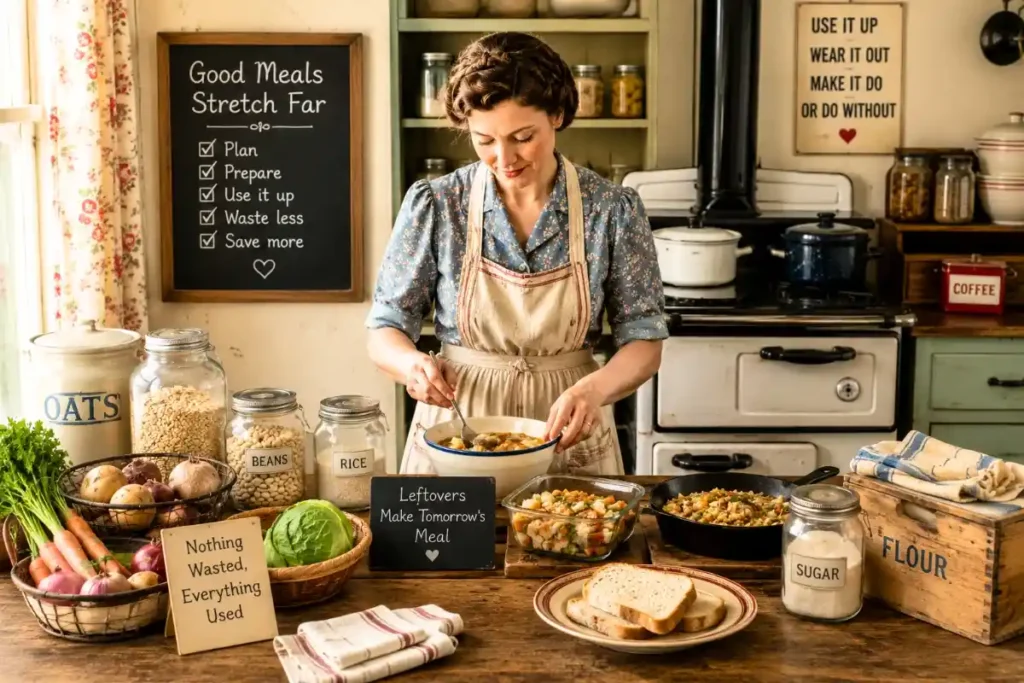
Food was one of the areas where families had to be especially resourceful during difficult economic times. Meals were often planned around inexpensive ingredients, available leftovers, and whatever food was already in the household.
The modern lesson is not to copy Depression-era meals.
It is to make the food you already buy work harder.
Leftover Night Can Be Planned
Instead of letting leftovers sit in the refrigerator until they are forgotten, choose one evening each week to use them.
Cooked vegetables can become part of an omelet, soup, pasta dish, or rice bowl. Leftover chicken can become sandwiches, wraps, soup, or another family meal.
You do not have to create complicated recipes.
The goal is simply to notice what needs to be eaten before buying more food.
Give Useful Food Scraps a Second Purpose
Some parts of food that people normally throw away can sometimes still be useful.
Vegetable trimmings can be collected for homemade stock if they are suitable. Fruit scraps can sometimes be composted. Bones from a meal can be used to make broth when practical.
Not every food scrap needs to be saved.
A better rule is to save only what you realistically know how to use.
That prevents frugality from turning into another form of clutter.
Choose Ingredients With More Than One Use
Modern convenience foods can save time, but they can also cost more because someone else has already done the preparation.
Depending on local prices, less-processed ingredients may offer better value.
A bag of rice, dried beans, oats, potatoes, eggs, or seasonal vegetables can often be used in several different meals.
The important question is not simply:
“What is cheapest?”
Ask:
“What can I use in several meals?”
That can make a grocery budget more flexible.
Clothing and Household Habits Worth Reviving
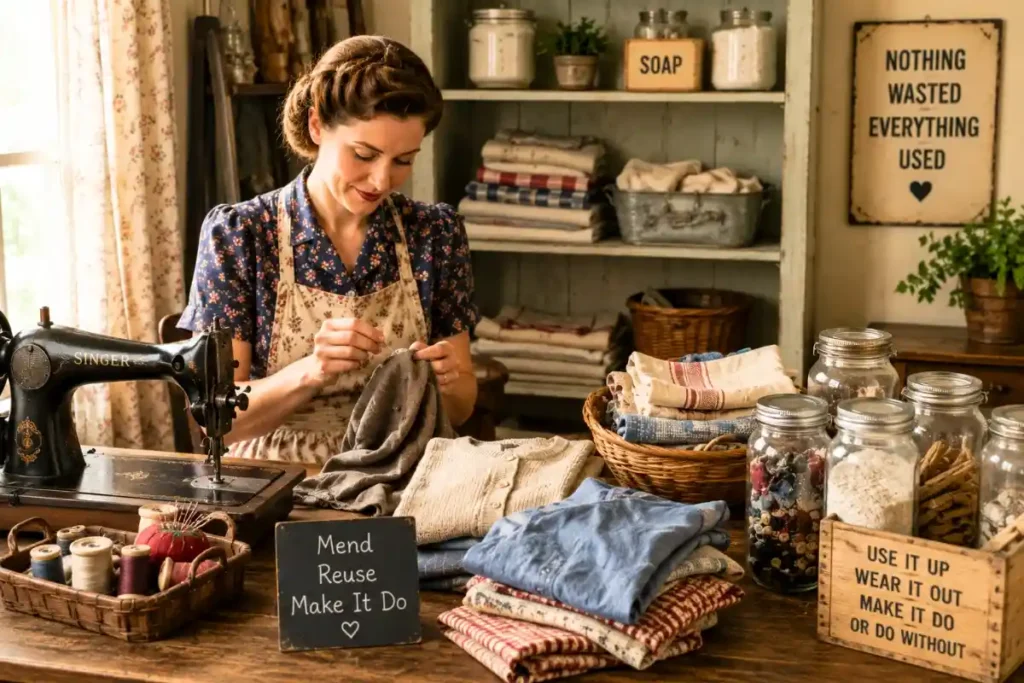
Many Depression-era households had strong habits around repairing, reusing, and getting more life from clothing and household items.
You can bring that idea into modern life without becoming overly restrictive.
| Old-fashioned habit | Why it helped | A modern version |
| Mending instead of replacing | Small repairs cost less than new items | Fix buttons, small tears, loose handles, or simple household problems |
| Reusing worn fabric | Useful material did not have to be wasted | Turn old towels or suitable clothing into cleaning cloths |
| Reusing containers | New storage was not always necessary | Reuse suitable jars and containers for household storage |
| Using items longer | Purchases happened less often | Look after everyday items and replace them when they are genuinely worn out |
The pattern is simple: an item does not have to be perfect to remain useful.
The Money Habits That Mattered More Than Any Coupon
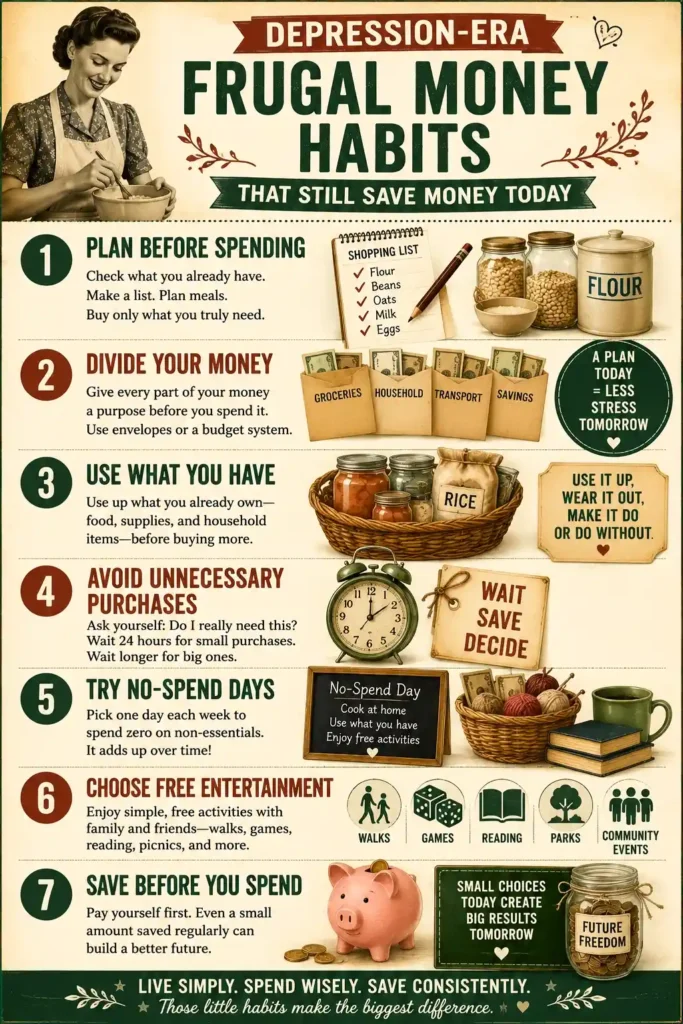
Saving money is not only about finding discounts.
Sometimes the biggest savings come from changing the way you decide when and why to spend.
Divide Your Spending Before You Spend It
A simple envelope-style system can make a household budget easier to understand.
You might separate money for:
- Groceries
- Household expenses
- Transportation
- Entertainment
- Savings
- Unexpected expenses
You do not have to use physical envelopes. Separate bank accounts, budgeting apps, or a written spending plan can work too.
The important part is giving each part of your money a purpose before it disappears into everyday spending.
Make No-Spend Days Normal
A no-spend day does not have to be an extreme challenge.
Choose one day each week when you avoid non-essential purchases.
Cook with what you already have. Skip online shopping. Avoid unnecessary delivery orders. Use free entertainment.
One day will not transform your finances by itself, but it can help you notice how often small purchases happen simply because spending has become automatic.
Find Free Ways to Enjoy Your Time
Families in the past had fewer paid entertainment options, so many forms of recreation were naturally inexpensive or free.
Today, you have far more choices, but free activities are still available.
Try:
- A family walk
- Board games you already own
- Reading
- Cooking together
- Free community events
- Visiting a local park
- Movie nights using services you already pay for
The goal is not to eliminate paid entertainment.
It is to stop assuming that every enjoyable activity needs another purchase.
Frugal Habits for Clothes, Shopping, and Everyday Spending
One of the easiest ways to save money is to slow down the replacement cycle.
Before buying something, especially something non-essential, ask yourself whether you are replacing a genuinely worn-out item or simply buying a newer version.
This is particularly useful with clothes, kitchen gadgets, home decorations, and children’s items.
A simple waiting period can help.
For small purchases, wait 24 hours.
For larger purchases, give yourself several days.
If you still need the item after waiting, compare prices and consider how often you will actually use it.
Sometimes the most frugal decision is not finding a better deal.
It is deciding that you do not need the item after all.
Buy for Value, Not Just for the Lowest Price
Being frugal does not always mean choosing the cheapest product.
A very inexpensive item that breaks quickly may cost more over time than a reasonably priced item that lasts much longer.
Before buying, consider:
- How often will I use it?
- How long is it likely to last?
- Can I repair it?
- Do I already own something similar?
- Is it a genuine need?
- Will buying it prevent another expense later?
This approach works in the US, UK, Canada, Europe, and elsewhere because it focuses on the value of the purchase rather than a specific currency or store.
Make “Use It Up” a Weekly Habit
One of the simplest old-fashioned money-saving habits is to finish what you already have.
You can apply it to food, toiletries, cleaning products, craft supplies, and household items.
Choose one category each week.
For example, if your pantry is crowded, make several meals using ingredients already sitting there. If you have several partly used cleaning products, finish them before buying another version.
The goal is not to use something that is unsafe or unsuitable.
It is simply to stop buying replacements while perfectly usable products are still sitting at home.
Try These Depression-Era Frugal Habits for One Week
You do not need to change your entire lifestyle overnight.
Try these habits for seven days:
- Check your kitchen before making a grocery list.
- Plan at least one meal around ingredients you already have
- Use leftovers before cooking or buying another meal.
- Repair one small item instead of replacing it.
- Choose one no-spend day.
- Delay every non-essential purchase for at least 24 hours.
- Write down purchases you wanted to make but decided to skip.
- Put a small amount toward savings before spending the rest of your discretionary money.
At the end of the week, look at what changed.
You may discover that some purchases were habits rather than genuine needs.
The Lesson Worth Taking From Depression-Era Frugal Living
The Great Depression was a period of serious economic hardship. Families experienced unemployment, falling incomes, food insecurity, and difficult living conditions.
So the goal should not be to romanticize that period or pretend that financial hardship was a good thing.
The useful lesson is the resourcefulness.
Many households had to think carefully about what they bought, what they wasted, what they repaired, and how long they could make something last.
Modern families can take that mindset without taking on the hardship.
You can still enjoy convenience, buy new things, and spend money on experiences you value.
The difference is making those choices intentionally.
Final Thoughts
The most useful frugal habits from the Great Depression are surprisingly simple.
Use what you already have.
Waste less food.
Repair what can reasonably be repaired.
Plan before shopping.
Buy items for their value rather than buying simply because something is on sale.
Give yourself time before making non-essential purchases.
None of these habits requires a special app or complicated budgeting system.
You do not need to live like a Depression-era household. But bringing a little of that resourceful mindset into modern life can help families in the US, UK, Canada, Europe, and around the world make everyday money go further.
Sometimes saving money starts with one very simple question:
“Do I really need to buy this, or can I make what I already have do?”
Frequently Asked Questions About Depression-Era Frugal Habits
What were some common frugal habits during the Great Depression?
Common habits included using food carefully, repairing clothing and household items, reusing useful materials, planning purchases, and avoiding unnecessary spending. The main idea was to get as much value as possible from what a family already had.
How did Depression-era housewives save money on food?
Many households tried to reduce food waste by planning meals around available ingredients, using leftovers, and choosing simple foods that could be stretched across several meals. Today, planning meals from your pantry and using leftovers before buying more can follow the same basic principle.
What is the “make do” mentality in frugal living?
The “make do” mentality means looking for a way to use, repair, adapt, or repurpose something before replacing it. It is one of the most useful old-fashioned frugal habits because it can reduce unnecessary purchases without requiring a complicated budgeting system.
Can Depression-era frugal habits still save money today?
Yes. Some habits are still practical, especially using what you already own, reducing food waste, repairing suitable items, delaying non-essential purchases, and planning your spending before shopping. Modern families do not need to copy Depression-era life; they can simply adapt the useful ideas to their own budget.
What are the best old-fashioned frugal habits to try first?
Start with three simple habits: check what you already have before shopping, use leftovers before buying more food, and wait before making non-essential purchases. Once these become natural, you can add other frugal habits such as repairing clothes, planning a grocery budget, or having a regular no-spend day.
More Money Saving Tips for Moms
If you want more simple ways to reduce everyday family expenses, explore these related guides:
• Budgeting for Stay-at-Home Moms: Simple Ways to Save Money
• Meal Planning on a Budget for Moms: Easy Family Ideas
• Newborn Baby Shopping List in Budget: Affordable Essentials for First-Time Moms
• How to Make a Grocery Budget: Simple Tips for Moms to Save Money
• Money Saving Tips for Moms: How to Manage Family Finances Smartly
• Money Saving Tips for Moms | Inspired by Real-Life Lessons
• How to Create a Personal Financial Plan for Women (Step-by-Step Guide)
Stay Connected ❤️
Loved these money-saving ideas? Save this article by sharing it on WhatsApp, subscribe with your email so we can send useful tips straight to your inbox, and don’t forget to follow us on LinkedIn for more simple ways to make your money go further.